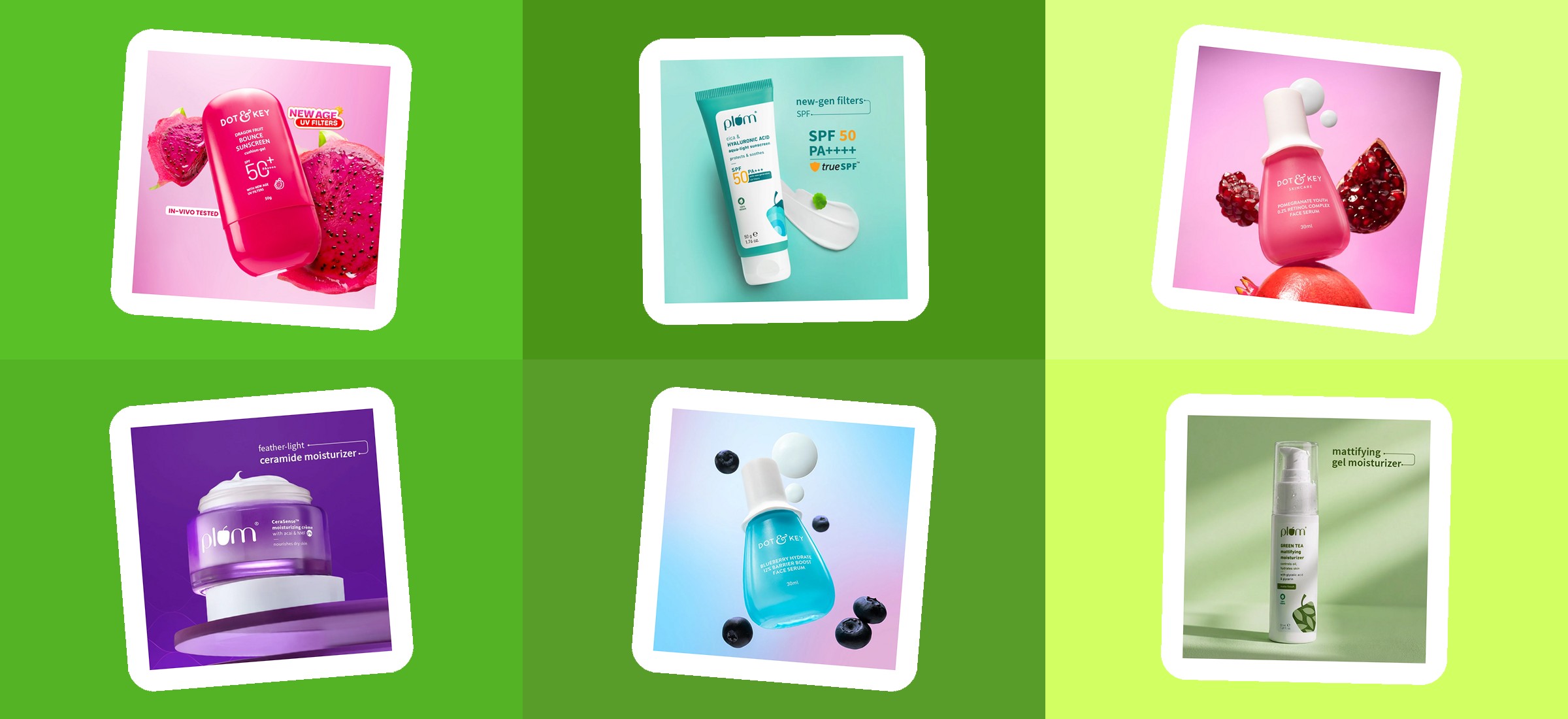
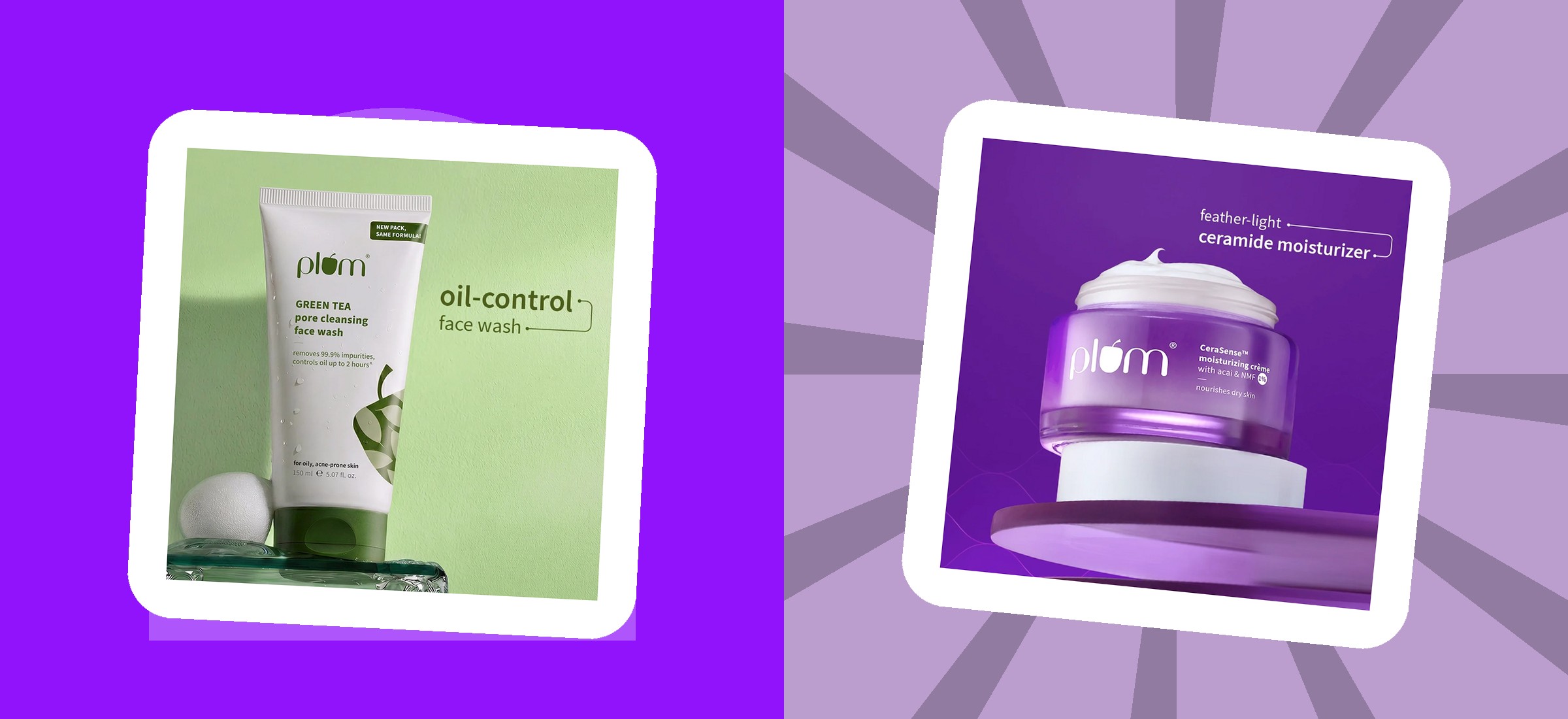
![Six skincare products from the four brands compared on this page — Dot & Key and Plum sunscreens, serums and moisturisers — arranged as a colour-block layout, on this page comparing D2C skincare prices per millilitre]()
One of these four brands takes 15 per cent off everything it sells. One takes 10. Two take nothing at all. Price the same sunscreen at each of them and the answers land within 24 per cent of each other.
We read the product feeds of Plum Goodness, Dot & Key, Minimalist and mCaffeine on 6 September 2026, all within the same hour, and compared what you actually pay per millilitre. Below: the four discount policies, three like-for-like product tables, and the reason a percentage badge cannot be compared across brands.
📅 Four feeds read 6 September 2026
Plum 15% · Minimalist 10% · Dot & Key 0% · mCaffeine 0%
SPF 50 sunscreen: Rs. 7.20 to Rs. 8.90 per unit
📅 Update log:
6 Sep 2026 — first published, from the four brands' own product feeds as served to a logged-out visitor on 6 September 2026. Discount policies and prices change without notice; we re-read the feeds and log any change to the 15 / 10 / 0 / 0 per cent structure here.
Four brands, four discount policies, read the same morning
We pulled the product feeds of four Indian direct-to-consumer skincare brands on 6 September 2026, all within the same hour, and the first thing that stands out is how little they agree on. Plum discounts everything by a flat 15 per cent. Minimalist discounts most things by a flat 10. Dot & Key discounts nothing at all — 151 listings, not one badge. mCaffeine mostly discounts nothing either, but scatters nineteen listings between 22 and 55 per cent off.
Four policies, and each of them is presented to the shopper as a fact about value. A flat 15 per cent looks like a brand that is generous. A brand with no discounts looks either premium or honest, depending on how you read it. A 55 per cent badge looks like a bargain.
So we did the obvious test: take the same product from each brand, in the same size, and compare what you actually pay. The results are on this page, and they are much duller than the badges are — which is the point.
| Brand | Listings read | Discount policy | What that looks like in the feed |
|---|
| Plum Goodness | 390 in stock | Flat 15% off on single products | 125 of 267 discounted non-gift listings at exactly 15%; combos at 19% and 23% |
| Minimalist | 76 in stock | Flat 10% off on most of the range | 59 of 76 listings at exactly 10%, a further 12 at 15%, 4 undiscounted |
| Dot & Key | 151 in stock | No discount at all | 151 of 151 listings sold at list price — no badge anywhere in the feed |
| mCaffeine | 193 in stock | Mostly no discount, with deep outliers | 174 of 193 at list price; 19 listings scattered between 22% and 55% off |
₹ Why compare per millilitre rather than per bottle. Pack sizes differ between brands and within them, so a sticker price is not comparable across a shelf. Every figure on this page divides the price you actually pay by the stated pack size, which is the only way to put four brands' prices next to each other honestly.
SPF 50 sunscreen: badges from 0% to 15%, prices 24% apart
Sunscreen is the fairest comparison available, because SPF and PA are standardised, measured ratings rather than marketing language. All four products below state SPF 50 and a PA rating of +++ or ++++, and all four come in a 50 gram or 50 millilitre pack. As close to like-for-like as this category gets.
The delivered prices run from Rs. 7.20 to Rs. 8.90 per unit — a 24 per cent spread. Here the two discounting brands do come out ahead of the two that do not, so this is the category where policy and price agree most. But even here the badges get the order wrong: Minimalist, at 10 per cent off, is cheaper than Plum at 15 per cent off. The smaller badge wins.
And the gap between the best and worst price in this table — Rs. 1.70 per gram, or Rs. 85 across a 50 g tube — is larger than any discount on the page produces. The next two tables show the agreement between policy and price breaking down completely.
| Brand | Product and size | You pay | Badge | Per unit |
|---|
| Minimalist | SPF 50 Sunscreen, 50 g | Rs. 360 | 10% off | Rs. 7.20 per g |
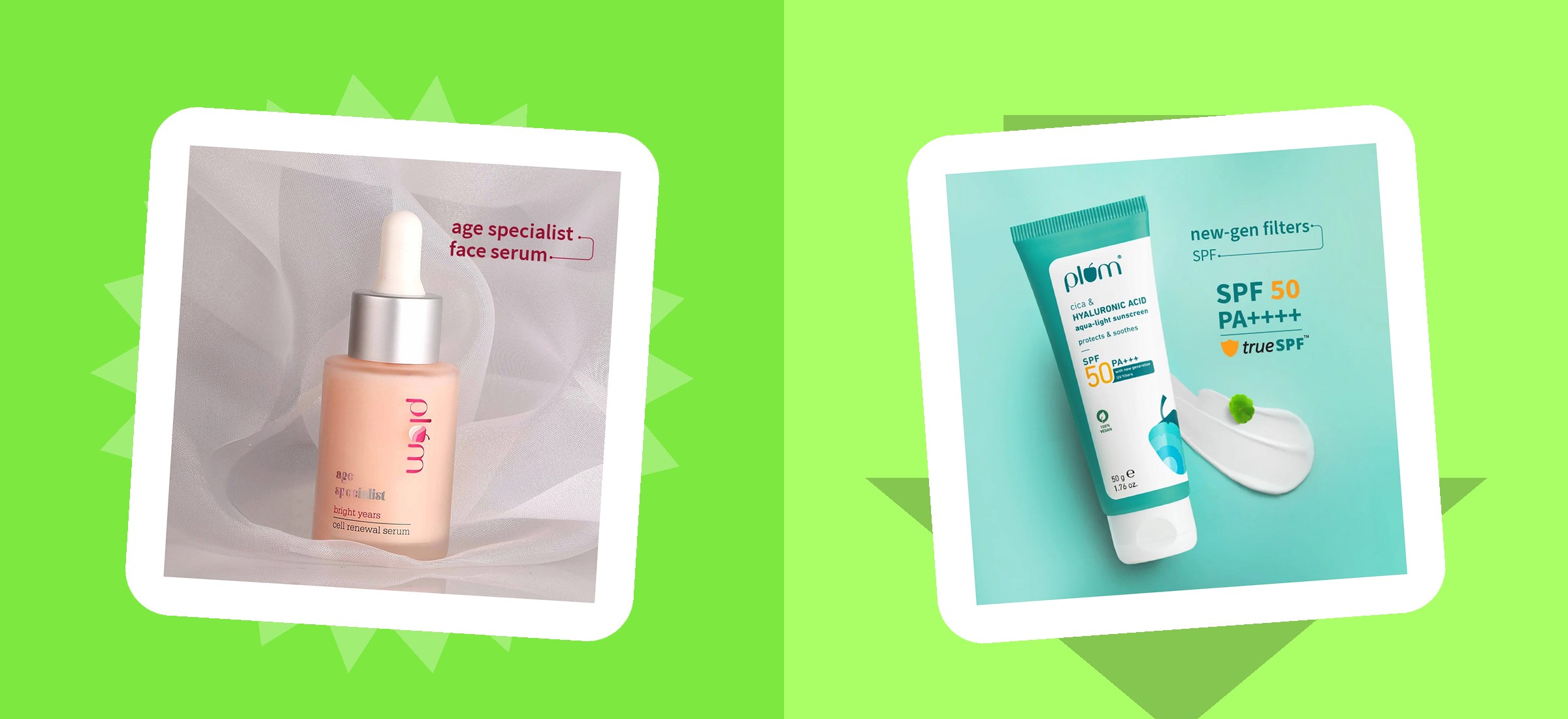
| Plum Goodness | Cica & Hyaluronic Acid Aqua-Light SPF 50 PA++++, 50 g | Rs. 382 | 15% off | Rs. 7.64 per g |
| mCaffeine | Green Tea Sunscreen SPF 50 PA++++ with Niacinamide, 50 ml | Rs. 399 | no discount | Rs. 7.98 per ml |
| Dot & Key | Dragon Fruit Bounce Gel Sunscreen SPF 50+ PA++++, 50 g | Rs. 445 | no discount | Rs. 8.90 per g |
₹ The number that is the same on all four. Every sunscreen in this table states SPF 50. Whatever you pay between Rs. 360 and Rs. 445, the stated protection is identical — and how much you apply will affect the protection you actually get far more than which of these four you buy. Most people apply roughly a quarter of the tested amount.
10% niacinamide serum: an 11 per cent spread across three brands
Niacinamide at 10 per cent in a 30 ml bottle is the most standardised product in Indian skincare — three of these four brands sell one, with the same headline concentration and the same pack size.
The prices land within eleven per cent of each other: Rs. 18.00, Rs. 18.67 and Rs. 19.97 per millilitre. And the ordering is once again unrelated to the badges. Minimalist at a 10 per cent discount is cheapest; Plum at 15 per cent is second; Dot & Key with no discount at all is dearest, by about two rupees a millilitre, or Rs. 59 across the bottle.
Two rupees a millilitre is a real difference and a small one. What it is not is the difference the badges imply. If a shopper picked Plum over Dot & Key because one showed 15 per cent off and the other showed nothing, they would have saved Rs. 39 on a Rs. 599 product — and if they had picked Minimalist on its smaller-looking 10 per cent badge, they would have saved more.
| Brand | Product and size | You pay | Badge | Per ml |
|---|
| Minimalist | Niacinamide 10% Face Serum, 30 ml | Rs. 540 | 10% off | Rs. 18.00 per ml |
| Plum Goodness | 10% Niacinamide & Rice Water Brightening Face Serum, 30 ml | Rs. 560 | 15% off | Rs. 18.67 per ml |
| Dot & Key | Strawberry Bright 10% Niacinamide Face Serum, 30 ml | Rs. 599 | no discount | Rs. 19.97 per ml |
Face wash: the brand with no discount undercuts the brand with 10 per cent
This is the table that settles it. A 100 ml gel face wash from three of the four brands, and the ordering inverts the discount policy almost completely.
Dot & Key, which discounts nothing, costs Rs. 2.49 per millilitre. Minimalist, which takes 10 per cent off, costs Rs. 2.70. The brand with no offer is cheaper than the brand with one. Plum, at 15 per cent off, is cheapest here at Rs. 2.42 — seven paise a millilitre below the undiscounted Dot & Key, or about seven rupees across the bottle.
Across all three categories the entire spread between the cheapest and dearest brand is 11 to 24 per cent, while the discount badges span zero to fifty-five. The conclusion is not that any of these brands is dishonest — every price on this page is exactly what the brand publishes. It is that a standing discount is a pricing structure, not a saving, and comparing badges across brands tells you nothing.
| Brand | Product and size | You pay | Badge | Per ml |
|---|
| Plum Goodness | Green Tea Pore Cleansing Face Wash, 100 ml | Rs. 242 | 15% off | Rs. 2.42 per ml |
| Dot & Key | Strawberry Bright Niacinamide Gel Face Wash, 100 ml | Rs. 249 | no discount | Rs. 2.49 per ml |
| Minimalist | Salicylic Acid + LHA 2% Cleanser, 100 ml | Rs. 270 | 10% off | Rs. 2.70 per ml |
What to do with all this
Never compare two brands on their discount percentages. They are measured against reference prices each brand sets for itself, so the comparison is meaningless before you start. On this page a 0 per cent badge beat a 10 per cent badge on face wash, and a 10 per cent badge beat a 15 per cent badge on both sunscreen and serum.
Compare the price you pay, divided by the pack size. It takes twenty seconds per product and it is the only comparison that survives four different pricing policies. It is also what shows that these four brands are, in the end, priced within a fifth of each other on the products they all sell.
Do not wait for a sale at Dot & Key or mCaffeine on the strength of this page. On the day we read them, one had no discounts on any of 151 listings and the other had none on 174 of 193. Waiting for a badge that the brand does not appear to issue is how people delay buying a sunscreen they need now.
Where the real money is, on all four sites, is pack size. Within a single brand we have repeatedly found size ladders worth far more than any discount tier — a 50 ml serum 27 per cent cheaper per millilitre than the 15 ml of the identical formula, or two moisturisers at one price with 20 per cent more in one jar. Those gaps are two to five times larger than the differences between the brands on this page.
How this comparison was made, and what it does not tell you
All four product feeds were read on 6 September 2026, within the same hour, from each brand's own Shopify feed as served to a logged-out visitor in India: plumgoodness.com (390 in-stock listings), dotandkey.com (151), beminimalist.co (76) and mcaffeine.com (193). Discount percentages are calculated from each listing's own selling price and compare-at price; a listing with no compare-at price above its selling price is counted as undiscounted. For the three product comparisons we selected, in each brand's range, the closest available match on category, headline active concentration and pack size, and compared the price actually charged rather than any list price. Where a brand does not sell a comparable product — mCaffeine has no 10 per cent niacinamide face serum in a 30 ml bottle, and its face washes are sold in sizes that do not match the others — it is left out of that table rather than matched to something different.
What that means for what you can conclude. These are not identical products. Formulas, textures, filter systems, supporting ingredients and packaging all differ between brands, and a price-per-millilitre comparison deliberately says nothing about any of that. We have not bought, applied, patch-tested or laboratory-verified any product here, have not assessed any efficacy, in-vivo testing or ingredient claim, and nothing on this page ranks these brands on quality — only on what a millilitre costs. SPF and PA ratings are quoted from the product listings as printed. Discount policies described here are one day's snapshot of four feeds; any of these brands can change its pricing at any time, and all four also sell through Nykaa, Amazon and Flipkart at prices those retailers set, which are frequently discounted and are outside this comparison. No claim is made about any brand's costs, margins, pricing intent or compliance with any rule, and no wrongdoing by any company named is alleged or implied. Nothing here is medical or dermatological advice. Zoutons may earn a commission if you buy through links on this page; it does not change what you pay, and nothing here was reviewed or approved by any of the brands named.
The short version
Four brands, four discount policies, and prices that land within a fifth of each other. Plum takes a flat 15 per cent off, Minimalist a flat 10, Dot & Key nothing at all across 151 listings, and mCaffeine nothing on 174 of 193. Badges from zero to fifty-five per cent.
Then compare what you pay. SPF 50 sunscreen: Rs. 7.20 to Rs. 8.90 per unit. A 10 per cent niacinamide serum: Rs. 18.00 to Rs. 19.97 per ml. A 100 ml face wash: Rs. 2.42 to Rs. 2.70 per ml. In every case the ordering has little to do with the discount — on face wash the brand with no discount undercuts the brand with 10 per cent off. Compare per millilitre, not per badge. Prices read 6 September 2026.
Frequently Asked Questions
Which Indian skincare brand is cheapest - Plum, Dot & Key, Minimalist or mCaffeine?
It depends on the product, and the gaps are smaller than the marketing suggests. In our 6 September 2026 read, Minimalist was cheapest on SPF 50 sunscreen (Rs. 7.20 per gram) and on 10 per cent niacinamide serum (Rs. 18.00 per ml), while Plum was cheapest on a 100 ml face wash (Rs. 2.42 per ml). Dot & Key was dearest on sunscreen and serum but beat Minimalist on face wash. Across all three categories the total spread between the cheapest and dearest brand was 11 to 24 per cent. None of these brands is systematically cheap or expensive — which is why the useful habit is to price the specific product you want per millilitre rather than picking a brand and trusting it.
Is a brand with no discount more expensive?
Not reliably, and this comparison is a clean test of that assumption. Dot & Key discounted nothing across all 151 of its in-stock listings on the day we read it, and mCaffeine discounted nothing on 174 of 193 — yet mCaffeine's SPF 50 sunscreen at Rs. 7.98 per ml sits within 11 per cent of the cheapest sunscreen in our table and comfortably below Dot & Key's Rs. 8.90, despite Dot & Key and mCaffeine running the same no-discount policy. The clearest case is face wash: the undiscounted Dot & Key at Rs. 2.49 per ml undercut Minimalist's 10-per-cent-off product at Rs. 2.70. A permanent discount and a permanent list price are two ways of arriving at the same shelf price.
Why do these brands have such different discount policies?
We can describe what the feeds show and should be careful about why. A standing flat discount, like Plum's 15 per cent or Minimalist's 10, keeps a visible badge on every listing while setting the shelf price wherever the brand wants it. A no-discount policy, like Dot & Key's, presents the list price as the real price. Both are ordinary commercial choices, and the delivered prices on this page suggest neither produces systematically better value than the other. We are not privy to any of these brands' costing or strategy and make no claim about their margins or intent. What we can say is the practical part: because each brand sets its own reference prices, discount percentages are not comparable between brands and should not be used to choose between them.
Does the discount matter at all, then?
Within a single brand, yes - it is the difference between the list price and what you pay, and it is real money. Across brands, no, because the reference prices are not comparable. The larger point from our reads of these catalogues is that pack size moves the per-unit price far more than any discount tier does. Within one brand we have found a 50 ml serum priced 27 per cent cheaper per millilitre than the 15 ml bottle of the identical formula, two moisturisers at one sticker price with 20 per cent more product in one, and Rs. 595 buying either 20 g of sunscreen stick or 110 ml of sunscreen spray. Those gaps are two to five times larger than the differences between the four brands compared here.
Are these products actually comparable?
On price per millilitre, yes; on everything else, no, and the distinction matters. We matched on category, headline active concentration and pack size — a 10 per cent niacinamide serum in 30 ml against another, an SPF 50 sunscreen in 50 g against another. That makes the arithmetic fair. It does not make the products the same: formulas, filter systems, textures, supporting ingredients and packaging all differ, and a sunscreen you dislike wearing protects you less than a dearer one you apply properly. We have not applied, tested or assessed any of these products, so nothing on this page is a judgement of quality. Where a brand had no comparable product — mCaffeine in the serum and face wash tables — we left it out rather than substitute something different.
Prices & codes last verified: 6 September 2026
Every price on this page was read on 6 September 2026, within the same hour, from the four brands' own Shopify product feeds as served to a logged-out visitor in India: plumgoodness.com (390 in-stock listings), dotandkey.com (151), beminimalist.co (76) and mcaffeine.com (193). Discount percentages are calculated from each listing's own selling price and compare-at price, and a listing with no compare-at price above its selling price is counted as undiscounted. For each product comparison we selected the closest available match in each brand's range on category, headline active concentration and pack size, and compared the price actually charged; where a brand had no comparable product it was left out of that table rather than matched to something different. Per-millilitre and per-gram figures are our own arithmetic over the listed price and the stated pack size. These are not identical products: formulas, UV filter systems, textures, supporting ingredients and packaging differ between brands, and this comparison deliberately says nothing about any of that. We have not bought, applied, patch-tested or laboratory-verified any product named here, have not assessed any efficacy, in-vivo testing or ingredient claim, and nothing on this page ranks these brands on quality — only on what a millilitre costs. SPF values, PA ratings and active-ingredient percentages are quoted from the listings as printed. Discount policies described here are a snapshot of four feeds on one day; any brand can change its pricing at any time, and all four also sell through Nykaa, Amazon, Flipkart and other retailers at prices set by those retailers, frequently discounted, and outside this comparison. No claim is made about any brand's costs, margins, pricing strategy, intent or compliance with any rule, and no wrongdoing by Pureplay Skin Sciences (India) Private Limited, Sirona Hygiene Private Limited, Uprising Science Private Limited, PEP Technologies Private Limited or any other company connected with the brands named is alleged or implied. Nothing here is medical, dermatological or financial advice; sun protection in particular depends far more on how much product is applied and how often it is reapplied than on which of these products is chosen. Zoutons may earn a commission if you buy through links on this page; it does not change what you pay, and nothing here was reviewed or approved by any brand named.






 Booking com
  Hostinger
  Dell
Dell  Udemy
Udemy  Agoda
Agoda  Nykaa
Nykaa  Myntra
  Ajio
Ajio