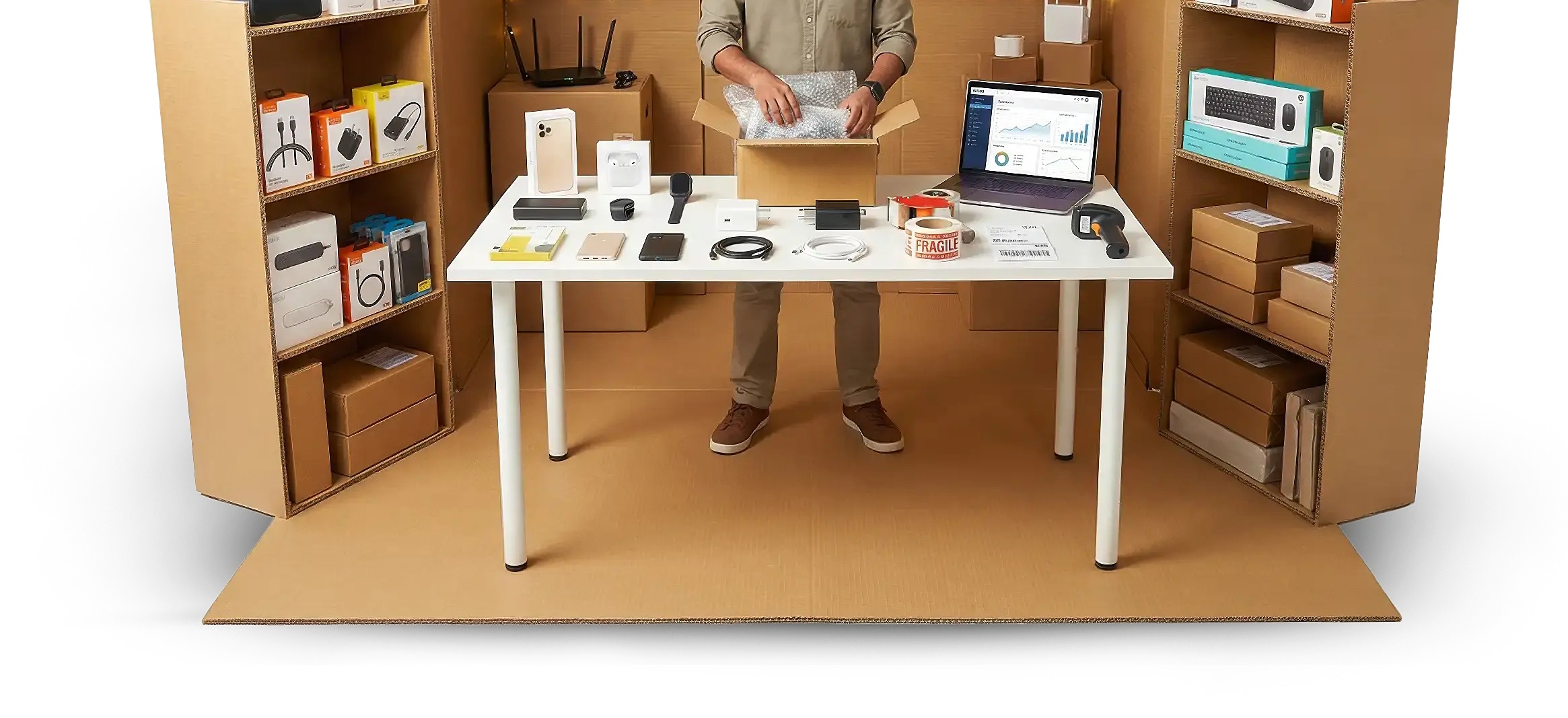
![An Amazon India seller packing orders at a desk stacked with phone cases, cables and accessories — the categories whose published referral fee runs from 0% below Rs. 1,000 to 30% above it]()
Amazon India publishes its whole seller rate card, and the structure in it is more useful than any single rate. Almost every category charges nothing below Rs. 1,000, then charges up to 30% of the entire price above it.
📅 Update log:
5 November 2026: first published. Read from Amazon India's own fees-and-pricing page at sell.amazon.in, logged out, from India. Every percentage, threshold and worked example is Amazon's own published figure; the rupee amounts in the cliff table are our arithmetic on those rates. The page carries a notice that closing fees changed effective 7 September 2026.
Amazon India publishes the whole referral-fee rate card at sell.amazon.in/fees-and-pricing. We read it on 5 November 2026, and the structure is more interesting than any single number in it.
Referral fee is charged as a percentage of the total selling price, and the percentage is banded by price. Amazon's own formula on the page is "Total Referral Fees = Item price x Referral Fee percentage", and its own worked example says a Rs. 1,450 baby apparel item at 7% pays Rs. 101.50.
Here is the part worth knowing: 133 of the 134 fee categories we could read start with a 0% band, and in 165 of the published bands that free window ends at exactly Rs. 1,000. Cross that line by one rupee and the percentage applies to the whole price, not to the rupee above the line.
These are seller fees, not shopper fees. Nothing on this page is added to your bill at checkout — the referral fee is what Amazon deducts from a seller's payout. It is worth reading anyway if you sell on Amazon, or if you have ever wondered why so many listings sit at Rs. 999 and Rs. 1,099 with almost nothing in between.
The Rs. 1,000 cliff, in rupees
Because the band applies to the whole price rather than the excess, the fee jumps from nothing to a real number across a two-rupee price change. These figures are the published percentage applied to the price shown — our arithmetic on Amazon's rates, not a figure Amazon prints.
| Fee category | Price | Referral fee | Price | Referral fee |
|---|
| Baby Products, Toys & Education | Rs. 999 | Rs. 0 | Rs. 1,001 | Rs. 300.30 |
| Cases, Covers and Skins, and Screen Guards | Rs. 999 | Rs. 0 | Rs. 1,001 | Rs. 250.25 |
| Apparel – Men's T-shirts | Rs. 999 | Rs. 0 | Rs. 1,001 | Rs. 230.23 |
| Clothing, Fashion, Jewellery, Luggage, Shoes | Rs. 999 | Rs. 0 | Rs. 1,001 | Rs. 190.19 |
| Curtains and Curtain Accessories | Rs. 999 | Rs. 0 | Rs. 1,001 | Rs. 165.17 |
| Bedsheets, Blankets and covers | Rs. 999 | Rs. 0 | Rs. 1,001 | Rs. 85.09 |
| Lawn & Garden – Solar Panels | Rs. 999 | Rs. 0 | Rs. 1,001 | Rs. 20.02 |
On a toy, pricing at Rs. 1,001 instead of Rs. 999 costs the seller Rs. 300.30 in referral fee to earn Rs. 2 more in revenue. The breakeven is not near Rs. 1,001 at all — at 30% a seller needs to clear roughly Rs. 1,430 before the post-fee take matches what Rs. 999 delivered.
That is the honest reason the Rs. 999 price point is so crowded on Indian marketplaces, and it is a fee-table artefact rather than a pricing fashion. It also means a Rs. 999 listing and a Rs. 1,099 listing are not 10% apart in seller economics — they can be a quarter apart.
The highest referral rates on the card
Every row below carries its own category label on Amazon's page and has no more than three published bands, so nothing here is stitched together from two categories.
| Fee category (Amazon's own label) | Below the threshold | Above the threshold |
|---|
| Baby Products, Toys & Education | 0% up to Rs. 1,000 | 30.00% above Rs. 1,000 |
| Consumable Physical Gift Card | 10% up to Rs. 300 · 29% Rs. 301–500 | 30.00% above Rs. 500 |
| Car Cradles, Lens Kits & Tablet Cases | 0% up to Rs. 300 · 5% Rs. 301–1,000 | 28.50% above Rs. 1,000 |
| Cases, Covers and Skins, and Screen Guards | 0% up to Rs. 1,000 | 25.00% above Rs. 1,000 |
| Apparel – Men's T-shirts (except Polos, Tank tops and full sleeve tops) | 0% up to Rs. 1,000 | 23.00% above Rs. 1,000 |
| Cables and Adapters – Electronics, PC and Wireless | 0% up to Rs. 1,000 | 20.00% above Rs. 1,000 |
| Clothing, Fashion, Fashion Accessories, Jewellery, Luggage, Shoes | 0% up to Rs. 1,000 | 19.00% above Rs. 1,000 |
| Pants – Trousers, Jeans, Trackpants and Leggings | 0% up to Rs. 1,000 | 19.00% above Rs. 1,000 |
| Smart Watches and Accessories | 0% up to Rs. 300 · 5% Rs. 301–1,000 | 17.00% above Rs. 1,000 |
| Curtains and Curtain Accessories | 0% up to Rs. 1,000 | 16.50% above Rs. 1,000 |
| Flip Flops, Fashion Sandals and Slippers | 0% up to Rs. 1,000 | 15.00%–16.00% above Rs. 1,000 by sub-category |
| Home Storage (excluding kitchen containers and bottles) | 0% up to Rs. 1,000 | 15.00% above Rs. 1,000 |
Toys and baby products top the card at 30%, which is the single highest clean rate we could read. Phone cases and screen guards sit at 25%, and men's T-shirts at 23% are dearer than the general clothing line at 19% — Amazon carves T-shirts out as their own category and prices them above the bucket they came from.
Note the shape of the T-shirt rule. Amazon's label is "Men's T-shirts (except Polos, Tank tops and full sleeve tops)", so a polo and a round-neck tee from the same brand do not necessarily sit in the same fee band at all.
If you sell, the category you list under is a pricing decision. The gap between the 30% row and the 2% rows is 15x on the same rupee of revenue, and Amazon assigns the fee by category rather than by what the product is called. The page carries a fee calculator for exactly this reason, and its own note says "Estimates are indicative. Actual fees may vary by category and fulfilment."
The cheapest rows, and what they have in common
| Fee category (Amazon's own label) | Below the threshold | Above the threshold |
|---|
| Health and Household – Medical Equipment, Sexual Wellness, Adult Incontinence, Elderly Care | 0% up to Rs. 1,000 | 2.00% above Rs. 1,000 |
| Health and Household – Regulated Healthcare: Menstrual Cups, Contact Lenses, Diagnostic Kits | 0% up to Rs. 1,000 | 2.00% above Rs. 1,000 |
| Lawn & Garden – Solar Panels | 0% up to Rs. 1,000 | 2.00% above Rs. 1,000 |
| Grocery & Gourmet – Oils | 0% up to Rs. 1,000 | 5.00% above Rs. 1,000 |
| Office products – Arts and Crafts | 0% up to Rs. 1,000 | 5.00% above Rs. 1,000 |
| Luggage – Suitcase & Trolleys | 0% up to Rs. 1,000 | 5.50% above Rs. 1,000 |
| PC Components – RAM and Motherboards | 0% up to Rs. 300 | 5.50% above Rs. 300 |
| Personal Care Appliances – Glucometer and Glucometer Strips | 0% up to Rs. 1,000 | 5.50% above Rs. 1,000 |
| Home Safety and Security Systems | 0% up to Rs. 1,000 | 6.00% above Rs. 1,000 |
| Health and Household – Ayurvedic, Homeopathic and Alternate Medicine | 0% up to Rs. 1,000 | 7.00% above Rs. 1,000 |
| Industrial, Medical, Scientific Supplies & Office Products | 0% up to Rs. 1,000 | 8.00% above Rs. 1,000 |
| Bedsheets, Blankets and covers | 0% up to Rs. 1,000 | 8.50% above Rs. 1,000 |
The 2% floor sits on regulated and medical goods — medical equipment, contact lenses, diagnostic kits, menstrual cups, elderly care — and on solar panels. Suitcases at 5.5%, cooking oils at 5% and RAM and motherboards at 5.5% are the next tier up.
Bulky, low-margin and regulated categories are cheap; small, high-churn, high-margin accessories are expensive. That is a coherent rate card rather than an arbitrary one, and it maps closely onto which categories a marketplace has to work hardest to win.
What the structure actually looks like
| What we counted on Amazon's page | Figure |
|---|
| Clean fee categories we could read with their own label | 134 |
| Of those, categories that open with a 0% band | 133 |
| Published bands whose 0% window ends at Rs. 1,000 | 165 |
| Published bands whose 0% window ends at Rs. 300 | 19 |
| Published bands whose 0% window ends at Rs. 500 | 8 |
| Highest above-threshold rate on a cleanly-labelled row | 30.00% (Baby Products, Toys & Education; Consumable Physical Gift Card) |
| Lowest above-threshold rate on a cleanly-labelled row | 2.00% (Medical Equipment; Regulated Healthcare; Solar Panels) |
| The spread between them | 15x |
One category on the page does not open at 0% — Consumable Physical Gift Card starts at 10% from the first rupee and reaches 30% above Rs. 500. Everything else we could read cleanly gives the seller a free band first.
How we read the table, and what we deliberately left out
Amazon's fee table has rows where the category label cell is blank — a sub-category inherits its heading visually but not in the markup. A naive parse glues those orphan bands onto the row above, which would have us reporting one category's ceiling under another category's name.
So every figure quoted on this page comes from a row that carries its own label and publishes no more than three bands. Categories with long band lists — Electronics, Headphones, Tablets, Beauty – Haircare, Bean Bags & Inflatables and the various "Other products" rows — are excluded from our maximum and minimum claims entirely, because we cannot be certain which band belongs to which label without the live page in front of us.
That means the real ceiling across the whole card could be higher than the 30% we report. What we can say is that 30% is the highest rate we could attribute to a named category with confidence, and the practical finding — a 0% band that ends in a cliff — does not depend on the ceiling at all. Use Amazon's own calculator on the page for a specific product.
What a seller actually pays, end to end
Referral fee is one of four lines. Amazon's own formula on the page is: Profit = Selling Price – (Referral Fee + Closing Fee + Weight Handling Fee + Other Applicable Fees + Product Cost).
The page also flags a live change: "Due to an increase in logistics costs, we are updating our closing fees, effective September 7, 2026." Shipping is quoted as starting at Rs. 37 per item shipped, varying by item volume and distance. So a Rs. 1,100 toy carries 30% referral, plus a closing fee, plus weight handling — which is why the Rs. 1,000 line matters even more than the referral table alone suggests.
The three things worth taking away
The referral fee is a cliff, not a slope. 133 of 134 clean categories start at 0%, and 165 published bands end that window at Rs. 1,000. Above the line the rate applies to the entire price.
The spread between categories is 15x. 30% on toys, baby products and consumable gift cards; 2% on regulated healthcare, medical equipment and solar panels. Category assignment is a bigger lever than price for most sellers.
Rs. 999 is a fee artefact. If you have wondered why Indian marketplace listings bunch just under round numbers, this rate card is a large part of the answer — and it is published, not inferred.
Frequently Asked Questions
What is Amazon's referral fee in India in 2026?
It is a percentage of the total selling price, banded by price and set by product category — and on Amazon's own published rate card the percentage runs from 2% to 30%. Read from sell.amazon.in/fees-and-pricing on 5 November 2026. The formula Amazon prints is "Total Referral Fees = Item price x Referral Fee percentage", and its own example says a Rs. 1,450 baby apparel item in a 7% category pays Rs. 101.50. The important structural detail is that 133 of the 134 cleanly-labelled categories open with a 0% band, and in 165 of the published bands that 0% window ends at Rs. 1,000. These are fees charged to sellers, not added to a shopper's bill.
Why do so many Amazon listings cost exactly Rs. 999?
Because the referral fee is 0% up to Rs. 1,000 in most categories, and above that line the percentage applies to the whole price rather than to the amount above the line. On Amazon's published rate card a toy at Rs. 999 pays Rs. 0 referral fee; the same toy at Rs. 1,001 pays 30% of Rs. 1,001, which is Rs. 300.30 — so two extra rupees of revenue costs three hundred rupees of fee. At 30% a seller needs to clear roughly Rs. 1,430 before the post-fee take matches what Rs. 999 delivered. That is our arithmetic on Amazon's own rates, and it is the clearest explanation for the crowding at Rs. 999.
Which Amazon India category has the highest seller fee?
Of the rows we could attribute to a named category with confidence, Baby Products, Toys & Education and Consumable Physical Gift Card are the highest at 30.00%. Car Cradles, Lens Kits & Tablet Cases follow at 28.50%, then Cases, Covers and Skins, and Screen Guards at 25.00%, and Apparel – Men's T-shirts at 23.00%. One caveat we want to be straight about: Amazon's table has rows whose label cell is blank, so we restricted every figure here to rows carrying their own label and no more than three published bands. Categories with long band lists are excluded from our maximum claim, so the true ceiling across the full card could be higher. Use the fee calculator on Amazon's page for a specific product.
Which categories have the lowest Amazon referral fee?
Regulated and medical goods sit at the 2.00% floor. Amazon's card lists 2% above Rs. 1,000 for "Health and Household – Medical Equipment, Sexual Wellness, Adult Incontinence, Elderly Care" and for "Regulated Healthcare: Menstrual Cups, Contact Lenses, Diagnostic Kits", and 2% for Lawn & Garden – Solar Panels. Just above them: Grocery & Gourmet – Oils and Office products – Arts and Crafts at 5.00%, Luggage – Suitcase & Trolleys at 5.50%, PC Components – RAM and Motherboards at 5.50%, and Personal Care Appliances – Glucometer and Glucometer Strips at 5.50%. The pattern is that bulky, low-margin and regulated categories are cheap and small high-margin accessories are expensive.
Is the referral fee the only thing Amazon charges a seller?
No. Amazon's own formula on the page is "Profit = Selling Price – (Referral Fee + Closing Fee + Weight Handling Fee + Other Applicable Fees + Product Cost)". So there is a closing fee set by price band, a weight handling or shipping fee if you use Easy Ship or Fulfilment by Amazon, and other fees depending on the service. The page quotes shipping as starting at Rs. 37 per item shipped, varying by item volume and distance, and carries a notice that closing fees were updated effective 7 September 2026 because of higher logistics costs. Amazon's own caveat applies: "Estimates are indicative. Actual fees may vary by category and fulfilment."
Prices & codes last verified: November 5, 2026
Every percentage, price threshold and worked example on this page was read from Amazon India's own seller fees and pricing page at sell.amazon.in/fees-and-pricing on 5 November 2026, logged out, from India. These are fees Amazon charges sellers. They are not added to a shopper's bill at checkout. The rupee figures in the Rs. 1,000 cliff table are our own arithmetic applying Amazon's published percentages to the prices shown, and are illustrative rather than quoted amounts. Amazon's fee table contains rows whose category label cell is blank, so every category quoted here was restricted to rows carrying their own label and publishing no more than three bands — categories with longer band lists are excluded from our maximum and minimum claims, and the true ceiling across the full card may be higher than the 30% we report. Amazon's own caveat on the page applies: "Estimates are indicative. Actual fees may vary by category and fulfilment." Referral fee is one of several lines — closing fee, weight handling fee and other fees also apply, and the page states closing fees were updated effective 7 September 2026. This is not business, tax or legal advice and is not a complete account of Amazon's seller terms. Use Amazon's own fee calculator for any specific product. Rates change without notice.









 Booking com
 Hostinger
 Dell
 Udemy
 Agoda
 Nykaa
 Myntra
 Ajio