India Festive Season Sales Statistics 2026: Spending, Dates and Trends

Update log · Last updated 22 September 2026
22 Sep: Page launched with the full 2025 scorecard and the first 2026 forecasts. Both flagship sales now have official dates: Amazon's Great Indian Festival opens 8 October (Prime early access from 7 October, announced 20 September) and Flipkart's Big Billion Days opens 9 October (Plus and Black members from 8 October). Diwali falls on 8 November. The 2026 rows in the tables below stay marked "forecast" until CAIT and Redseer publish post-Diwali numbers; we update this page the week they land.
Figures last verified: 22 September 2026, against CAIT, Redseer, NPCI, Datum Intelligence, Hansa Research and the Amazon, Flipkart and Myntra press releases
India's festive season is no longer one big Diwali week. It is a ten-week run from Navratri to Bhai Dooj in which the country spent a record Rs. 6.05 lakh crore last year, a quarter more than in 2024, and in which the two biggest online sales now open on the same morning. This page collects the numbers that matter for a shopper planning the 2026 season: how much India spends and where, how large the online slice has become, what Amazon, Flipkart and Myntra actually reported after their 2025 sales, which categories and cities drive the growth, and what the forecasts say about the season that opens on 8 October. Every figure is sourced and dated; the deals themselves live on our Amazon coupons page and its Flipkart and Myntra counterparts.
The festive season in six numbers
Festive season 2026: the dates that matter
The 2026 calendar runs later than 2025's. Navratri starts 11 October and Diwali lands on 8 November, so the sales that opened in late September last year now open in the second week of October. Both marketplaces confirmed their dates in the third week of September.
| Event | 2026 date | Status |
|---|---|---|
| Amazon Great Indian Festival | 8 October (Prime early access from 7 October) | Official, announced 20 September |
| Flipkart Big Billion Days | 9 October (Plus and Black early access 8 October) | Official |
| Myntra Big Fashion Festival | Ran 20 September to 5 October in 2025; 2026 dates not announced | Expected early October |
| Navratri | 11 October | Calendar |
| Dussehra | 20 October | Calendar |
| Dhanteras | 6 November | Calendar |
| Diwali (Lakshmi Puja) | 8 November | Calendar |
| Bhai Dooj | 11 November | Calendar |
Sale dates from Amazon's and Flipkart's own announcements, verified 22 September 2026. This is the fifth straight year the two sales have opened together.
Total festive trade: Rs. 6.05 lakh crore and a 25% jump
The Confederation of All India Traders (CAIT) measures festive trade across 60 distribution hubs in metros and Tier-2 and Tier-3 cities between the start of Navratri and Diwali. Its 2025 report is the benchmark number for the season: Rs. 5.40 lakh crore in goods plus Rs. 65,000 crore in services, a total of Rs. 6.05 lakh crore, against Rs. 4.25 lakh crore in 2024.
| Year | Festive trade (Navratri to Diwali) | Change |
|---|---|---|
| 2023 | Rs. 3.75 lakh crore | – |
| 2024 | Rs. 4.25 lakh crore | +13% |
| 2025 | Rs. 6.05 lakh crore | +25% |
| 2026 | To be published by CAIT after Diwali (8 November) | Forecast pending |
Three details from the same report explain the shape of that spending. Traditional and non-corporate markets still took about 85% of the value, so the online boom sits on top of a very large offline base rather than replacing it. Around 50 lakh temporary jobs were created, mostly in logistics, retail and delivery. And 87% of surveyed consumers said they preferred Indian-made goods, with 72% of traders crediting the September 2025 GST rate cuts on garments and household items for the lift.
Online festive sales: from Rs. 1.15 lakh crore to a Rs. 1.5 lakh crore forecast
Redseer, the consultancy whose festive tracker the industry quotes, estimated 2025 festive-month e-commerce GMV at Rs. 1.15 lakh crore, the strongest festive period for online retail in five years. Its first-leg reading covered the opening 11 days of the sales, when Amazon, Flipkart and Myntra all ran their main events at once.
| Online festive metric | 2025 | 2026 forecast (Datum Intelligence) |
|---|---|---|
| Festive-season online GMV | Rs. 1.15 lakh crore (Redseer estimate); Rs. 1.20 lakh crore (Datum base) | Rs. 1.50 to 1.55 lakh crore, up 25-29% |
| First 11 days GMV | Rs. 60,000 to 62,000 crore, up 20-22% | – |
| Online festive shoppers | About 9 crore in the first 11 days; 13.8 crore across the season | 15.8 crore |
| Orders | 76 crore | 96.6 crore, up 27% |
| Average order value | Rs. 1,578 | Rs. 1,554 |
| Average spend per shopper, first 11 days | About Rs. 7,000 | – |
The forecast's mechanics matter more than its headline. Datum expects the growth to come from two crore extra shoppers and 27% more orders, while the average order value dips slightly. In other words, 2026 is projected to be a season of more people buying more things at a marginally lower ticket, not of fewer people spending big. By category, the same forecast gives mobile phones 29.8% of online festive GMV, lifestyle 15.5% and appliances 13.6%.
The 2025 sale-by-sale scorecard
Each platform publishes its own post-sale numbers, and they measure different things, so read the table as three separate report cards rather than a ranking.
| Sale (2025 edition) | What the platform reported |
|---|---|
| Amazon Great Indian Festival | 276 crore customer visits, 70% from Tier-2 and Tier-3 cities. More than Rs. 1,000 crore of customer savings through bank offers, GST benefits and cashback. Over 4 crore Prime orders delivered same-day or next-day; same-day deliveries up 60% year on year. About 70% of new Prime members from Tier-2 and Tier-3 cities, and more than two-thirds of participating small businesses from the same markets. |
| Flipkart Big Billion Days | 60.6 crore visits in the first 48 hours, 20.1 crore of them from Gen-Z shoppers. Peak of 7.3 million shipments in a single day, more than 5,000 a minute at peak and over 3 lakh an hour on average. Same-day and next-day deliveries up 44%. Over 4 lakh seasonal jobs created. |
| Myntra Big Fashion Festival | 2 million new customers, with non-metros contributing 70% of orders. Ethnic wear demand up 2.5 times; wedding collections, beauty and sportswear the other growth categories. Strongest traction from Jaipur, Lucknow, Indore and Faridabad. Catalogue of 4 million-plus styles from 15,000 brands. |
Two threads run through all three: the growth is coming from outside the big metros, and the platforms are competing on delivery speed as hard as on price. Amazon's same-day number and Flipkart's shipment peak are both logistics claims, and both will be the metrics they try to beat in October.
Where the shoppers are: Tier-2 and Tier-3 cities
Every 2025 data set points the same way. Amazon's 70% of visits, Myntra's 70% of orders and Redseer's estimate that 60% to 65% of first-leg online shoppers came from Tier-2 cities and beyond describe the same shift: the marginal festive shopper now lives in Jaipur, Lucknow or Indore, not Mumbai or Delhi. CAIT's offline survey adds that rural and semi-urban India accounted for roughly 28% of total festive trade.
For 2026 the platforms are building for that customer. Amazon India has created over 1.6 lakh seasonal roles across more than 400 cities ahead of the season, including Varanasi, Kochi, Jalandhar, Ranchi, Salem and Gorakhpur, to support both its marketplace and its quick-commerce operations. Expect the same-day delivery footprint, not just the discount depth, to be a headline in the October results.
What India buys: category shares
CAIT's 2025 breakdown of festive trade by value shows how broad the season's spending is. Grocery leads, gold is second, and electronics, durables and clothing sit in a tight band behind them.
| Category | Share of 2025 festive trade (CAIT) |
|---|---|
| FMCG and grocery | 12% |
| Gold and jewellery | 10% |
| Electronics and electricals | 8% |
| Consumer durables | 7% |
| Ready-made garments | 7% |
| Gift items | 7% |
| Home decor | 5% |
| Furniture and furnishing | 5% |
| Sweets and namkeen | 5% |
| Textiles and fabrics | 4% |
| Other goods | 19% |
Online, the mix tilts hard to electronics: Datum's 2026 forecast has mobile phones alone at almost 30% of festive GMV. Intent surveys tilt the other way. In Hansa Research's 2026 festive study, fashion is the most-planned category at 69% of respondents, ahead of home decor and furniture at 51%, electronics and gadgets at 50%, sweets and snacks at 43% and jewellery at 35%. The same study found 95% of respondents planning to spend more than usual this season, with 45% expecting to spend 25% to 50% more and 22% planning to spend over 50% more.
Quick commerce: from 8% to 12% of online festive sales, and heading for 16%
The fastest-moving line in the festive data is the ten-minute one. Quick commerce's share of online festive sales rose from 8% in 2024 to 12% in 2025, with festive GMV of roughly $1.6 billion, about double the previous year. On peak Diwali days in 2025, Blinkit crossed 30 lakh orders a day, Zepto crossed 20 lakh and Swiggy Instamart reached 16 lakh, and brands selling gifting, puja essentials and home decor on these apps reported three to five times their normal order volumes in the final Diwali week.
Datum Intelligence expects the share to climb to almost 16% in 2026, or about Rs. 24,000 crore of festive spending. Amazon and Flipkart have both built quick-commerce arms (Amazon Now and Flipkart Minutes) into their festive plans, which is why the season's last ten days, once a dead zone for online delivery, are now a contested window for gifts, sweets and last-minute decor.
How India pays: UPI's record Diwali
Payments data gives the cleanest read on festive intensity because it is published daily by NPCI. On Diwali eve 2025, UPI processed an all-time high of about 74 crore transactions in a single day, and October 2025 averaged Rs. 94,000 crore of UPI value per day, 13% above September. UPI value crossed Rs. 1 lakh crore on Dhanteras itself.
The run-in to the 2026 season is already ahead of that base. In August 2026, UPI recorded 24.51 billion transactions worth Rs. 29.82 lakh crore, its highest monthly volume ever, up 22% in volume and 20% in value on August 2025, at an average of 79.1 crore transactions a day. For shoppers the practical point is that UPI is now the default rail for festive checkout, and the bank offers on the big sales have followed: SBI cards at the Great Indian Festival and Axis and ICICI cards at Big Billion Days, each at 10% instant discount, are where the extra saving sits on top of the listed price.
What the numbers mean for a shopper in October 2026
Four practical conclusions fall out of the data above.
| Finding | What to do with it |
|---|---|
| Both flagship sales open 8 to 9 October, a fortnight later than in 2025 | Use the extra two weeks to price-track the items on your list now, so the 8 October "deal" price can be judged against a real September baseline. |
| Mobiles are almost 30% of online festive GMV, and platforms compete hardest there | Phones are where the bank-offer stacks and exchange bonuses are deepest. Buy phones inside the sale window; buy everything else when the specific item is cheapest, which is often not day one. |
| Average order value is forecast to fall while order counts rise 27% | Expect more coupon-driven, threshold-based offers (minimum cart values) rather than blanket discounts. Combine small purchases to clear thresholds. |
| Quick commerce takes about 16% of the season, concentrated in the last Diwali week | Bulk electronics and fashion go through the marketplace sales in October; gifts, sweets and decor can wait for the ten-minute apps in the first week of November without paying a rush premium. |
Working codes for every platform in this article are tracked daily on our Flipkart coupons page and Myntra coupons page; we do not print codes here because they rotate through the season.
Sources and how we count
Total festive trade: CAIT "Research Report on Diwali Festival Sales 2025", surveyed across 60 distribution hubs between 29 September and 20 October 2025, as reported by Business Today and cait.in. Online GMV: Redseer festive tracker (season estimate and first-11-day reading) and Datum Intelligence's 2026 forecast as reported by Deccan Chronicle. Platform results: Amazon India's Great Indian Festival 2025 results on aboutamazon.in; Flipkart's supply-chain release on stories.flipkart.com and its BBD 2025 visit numbers; Myntra's Big Fashion Festival results as reported by Business Standard and Deccan Herald. Payments: NPCI monthly data as reported by Business Standard and Medianama; Diwali 2025 daily peaks as reported by YourStory and DD News. Consumer intent: Hansa Research Festive Insights 2026 as reported by BestMediaInfo. Quick commerce: platform peak-day figures and share estimates as reported by Business Standard and Exchange4media. Where two sources give different figures for the same metric (for example Redseer's Rs. 1.15 lakh crore and Datum's Rs. 1.20 lakh crore for 2025 online GMV) we show both and name each. Figures are in crore and lakh crore as the sources publish them; 1 lakh crore = 1 trillion rupees.
FAQ
Q. How much did India spend during the festive season in 2025?
A. The Confederation of All India Traders (CAIT) put festive trade for the Navratri-to-Diwali window of 2025 at a record Rs. 6.05 lakh crore: Rs. 5.40 lakh crore in goods and Rs. 65,000 crore in services. That was 25% above the Rs. 4.25 lakh crore recorded in 2024, and the highest festive figure in India's retail history.
Q. How big is India's festive e-commerce market?
A. Redseer estimated festive-month online GMV at about Rs. 1.15 lakh crore for 2025, with the first 11 days of the sales alone crossing Rs. 60,000 crore. For 2026, Datum Intelligence forecasts online festive sales of Rs. 1.50 to 1.55 lakh crore, a rise of 25% to 29%.
Q. When do the 2026 festive sales start?
A. Amazon announced on 20 September 2026 that the Great Indian Festival opens on 8 October, with Prime members getting 24-hour early access from 7 October. Flipkart's Big Billion Days opens to everyone on 9 October, with Plus and Black members in from 8 October. Diwali itself falls on 8 November 2026.
Q. How many Indians shop online during the festive sales?
A. Around 90 million shoppers bought online in the first 11 days of the 2025 festive sales, spending close to Rs. 7,000 each on average, according to Redseer. Datum Intelligence expects the 2026 season to draw about 158 million festive shoppers, up from 138 million last year.
Q. Which cities drive festive shopping in India?
A. Smaller cities do. Amazon reported that 70% of its 276 crore Great Indian Festival 2025 visits came from Tier-2 and Tier-3 cities, Myntra said 70% of Big Fashion Festival orders came from non-metros, and Redseer counted 60% to 65% of first-leg shoppers from Tier-2 and beyond.
Q. What sells most during the Indian festive season?
A. By value, CAIT's 2025 breakdown put FMCG and grocery first at 12% of festive trade, followed by gold and jewellery at 10%, electronics and electricals at 8%, and consumer durables and ready-made garments at 7% each. Online, Datum Intelligence expects mobile phones to take almost 30% of 2026 festive GMV.
Related reads
Amazon Great Indian Festival 2026: dates and offers · Flipkart Big Billion Days 2026: dates and what to buy · Myntra Big Fashion Festival sale · Amazon upcoming sales calendar · Flipkart upcoming sales calendar · Nykaa sale calendar 2026 · Ajio upcoming sale calendar 2026 · Amazon Summer Sale vs Great Indian Festival
Zoutons may earn a commission when you buy through links on this page. All statistics were verified on 22 September 2026 against the named sources; 2025 figures are final as published, 2026 figures are forecasts or announcements and are labelled as such. Sale dates come from the platforms' own announcements and can change; confirm on the sale page before you plan a purchase around them. By Zoutons Editorial Team.

Trending
 Flipkart Big Billion Days 2026 Is Live: General Access Open October 9
  Myntra Sale Calendar 2026: Big Fashion Festival Live Now, Winter EORS Dates
  Amazon Upcoming Sale Calendar 2026: Next Sale Dates India, GIF & More
  Nykaa Sale Calendar 2026: Diwali Dhamaka & Pink Friday Dates, Next Sale
 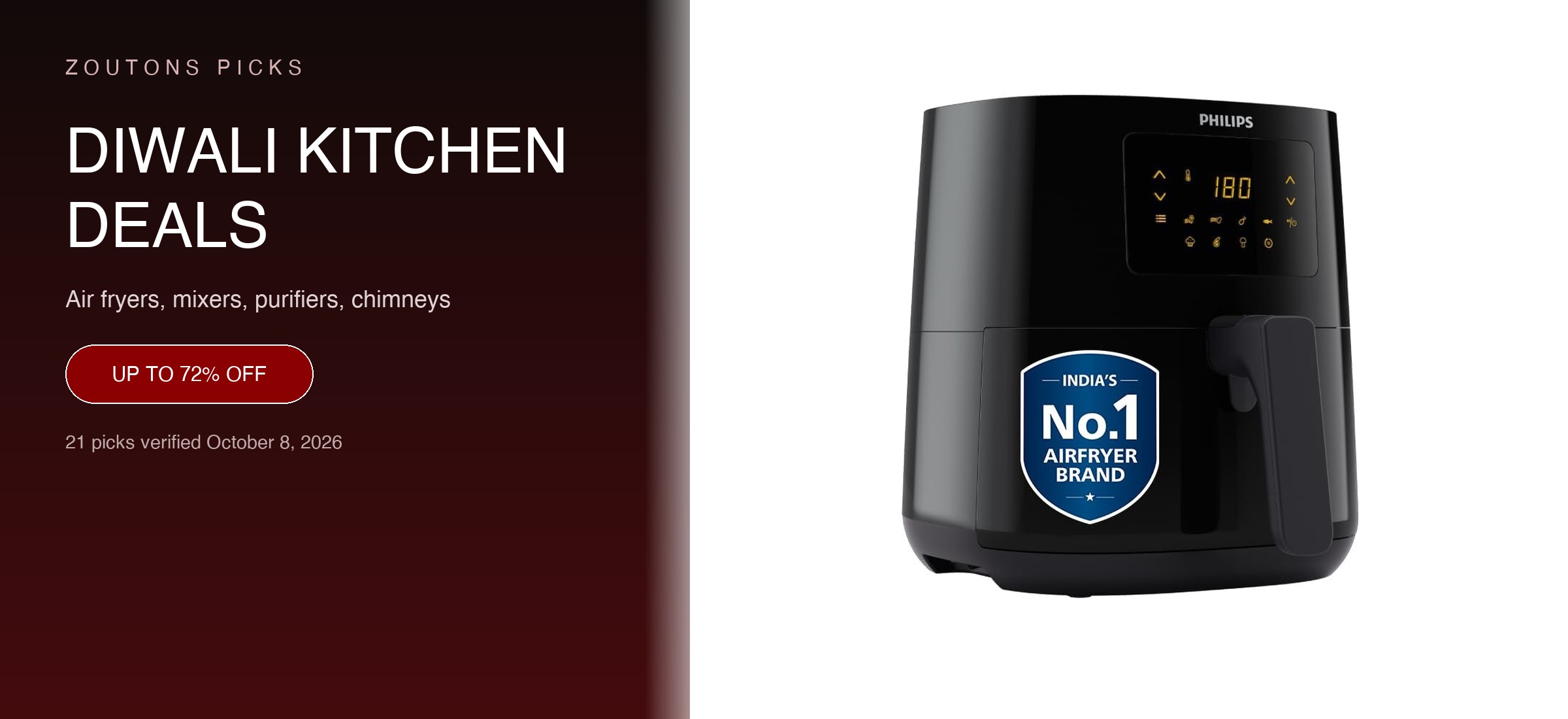 Amazon Great Indian Festival Kitchen Offers October 2026: Air Fryers, Mixers
  Udemy Upcoming Sale 2026: Next Sale Dates, Black Friday & Coupons
 More From Amazon







 Booking com
  Hostinger
  Dell
Dell  Udemy
Udemy  Agoda
Agoda  Nykaa
Nykaa  Myntra
  Ajio
Ajio