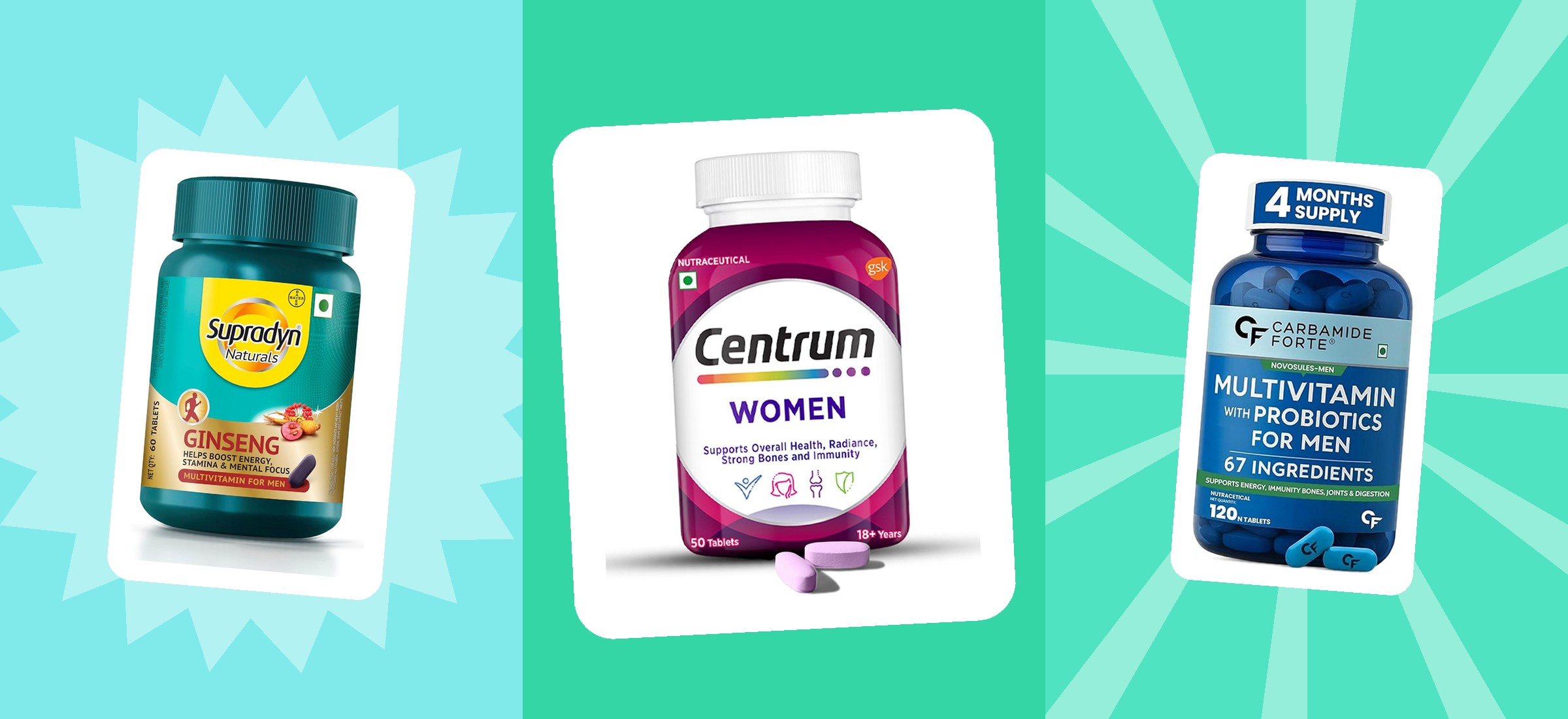
![Three of the multivitamin bottles priced on this page - Supradyn Naturals Ginseng, Centrum Women and Carbamide Forte Multivitamin for Men - shown as they appear on their Amazon listing pages]()
Supplements are priced by the bottle and taken by the tablet, and the bottles on this shelf hold 15, 30, 60, 90, 120 or 400 of them. Amazon prints the per-tablet rate under the price; we read it across 93 listings on 19 September 2026.
One multivitamin tablet costs Rs. 1.73 on this shelf and another costs Rs. 24.87 - Rs. 52 a month against Rs. 746 for the same daily habit. Nothing on this page is medical advice: whether to take a supplement at all is a question for a doctor, and this is only what the answer costs.
💊 Amazon supplement shelf read 19 September 2026
Cheapest multivitamin: Becadexamin, Rs. 1.73 a capsule - about Rs. 52 a month
Median across 93 listings: Rs. 7.63 a tablet
📅 Update log:
19 Sep 2026 — first published. Every price and unit rate on this page was read on 19 September 2026 from amazon.in's own search results, logged out, in India, across three queries. Amazon's catalogue and its unit labels change daily and the live listing is always authoritative; we re-read shelves like this one periodically and log what has changed here.
A supplement is sold as a bottle and taken as a tablet
Bottle prices on this shelf tell you almost nothing, because the bottles hold 15, 30, 50, 60, 90, 120 and 400 tablets. Amazon publishes the figure that does compare them - a per-count rate in brackets under the price - and on 19 September 2026 we read three searches and kept the 93 listings whose per-tablet rate is internally consistent with their own titles.
Across those, the shelf runs from Rs. 1.63 a tablet to Rs. 28.55, with a median of Rs. 7.63. Eight listings sit under Rs. 3 and ten above Rs. 15. Because almost everything here is taken once a day, that range converts directly into a monthly habit: roughly Rs. 49 at the floor and Rs. 857 at the ceiling.
Nothing on this page is medical or nutritional advice. Whether anybody needs a supplement at all, and which one, is a question for a doctor - many of these products are taken on the basis of a blood test rather than a preference. What a price table can do is show you what the same daily habit costs from one aisle to the next.
| The measure | Amazon, 19 Sep 2026 |
|---|
| Listings priced per tablet | 93 |
| Cheapest per tablet | Rs. 1.63 |
| Median per tablet | Rs. 7.63 |
| Dearest per tablet | Rs. 28.55 |
| Listings under Rs. 3 a tablet | 8 |
| Listings above Rs. 15 a tablet | 10 |
| Multivitamins: median per tablet | Rs. 10.57 |
| Calcium: median per tablet | Rs. 9.15 |
Multivitamins: Rs. 1.73 to Rs. 24.87 for one tablet
Thirty-four multivitamin listings published a usable per-tablet rate, and they span fourteen times. The cheap end is the Indian pharmacy shelf - products that have been sold through chemists for decades and are priced like medicines. The expensive end is direct-to-consumer wellness branding, sold in 30 and 90-tablet bottles with long ingredient lists.
| The listing | Price | Per tablet | A month, one a day |
|---|
| Becadexamin, bottle of 60 capsules | Rs. 103 | Rs. 1.73 | Rs. 52 |
| Supradyn Daily for Women | Rs. 279 | Rs. 3.10 | Rs. 93 |
| Supradyn Daily, strip of 15 | Rs. 68 | Rs. 4.55 | Rs. 137 |
| Carbamide Forte Multivitamin for Men | Rs. 749 | Rs. 6.24 | Rs. 187 |
| Centrum Women | Rs. 407 | Rs. 13.57 | Rs. 407 |
| TrueBasics Advanced Multivitamin, 90 tablets | Rs. 1,579 | Rs. 17.54 | Rs. 526 |
| Miduty Multivitamin with Veg Omega 3 | Rs. 746 | Rs. 24.87 | Rs. 746 |
The first and last rows are the page in miniature. Becadexamin, a multivitamin that has been on Indian chemist shelves since long before wellness was a category, is Rs. 1.73 a capsule - Rs. 52 a month. Miduty's multivitamin is Rs. 24.87 a tablet - Rs. 746 a month. Both are once-daily multivitamins. The formulations are not identical and we are not claiming they are interchangeable; ingredient lists, doses and added extras like omega-3 or probiotics genuinely differ, and none of that is testable from a listing.
What is testable is the arithmetic, and it is worth doing before a subscription starts. Over a year, the gap between those two rows is Rs. 8,330. Between the median of Rs. 10.57 and Becadexamin it is Rs. 3,182. If a doctor has recommended a specific formulation, buy that one - but if the choice is open, the per-tablet figure is the only number on the page that compares like with like.
Vitamin D: the weekly capsule against the daily tablet
Vitamin D is the clearest case on this shelf of format changing the price of a habit. Prescription-strength 60,000 IU capsules are typically taken once a week, while over-the-counter 1,000 and 2,000 IU tablets are taken daily. Per unit the weekly capsules look expensive - Rs. 9.68 to Rs. 28.55 each against Rs. 4.30 for a daily tablet - and per month the order reverses.
| The format | Price | Per capsule or tablet | Cost a month |
|---|
| Carbamide Forte 60,000 IU | Rs. 387 | Rs. 9.68 | About Rs. 42 at one a week |
| Super D3 60,000 IU, strip of 4 | Rs. 66 | Rs. 16.71 | About Rs. 72 at one a week |
| 60K chewable, cholecalciferol 60,000 IU | Rs. 76 | Rs. 19.00 | About Rs. 82 at one a week |
| Tata 1mg Vitamin D3 60K IU | Rs. 164 | Rs. 20.50 | About Rs. 88 at one a week |
| Uprise-D3 60K, strip of 12 | Rs. 342 | Rs. 28.55 | About Rs. 123 at one a week |
| Carbamide Forte D3 2,000 IU daily tablet | Rs. 387 | Rs. 4.30 | About Rs. 129 at one a day |
Read that table as price information and nothing else. Dosage is a medical decision. A 60,000 IU capsule is a prescription-strength dose normally given weekly for a defined period after a blood test shows a deficiency, and it is not a substitute for a low-dose daily supplement or vice versa. Taking high-dose vitamin D without medical supervision can be harmful. We are reporting that the two formats, both widely sold, cost very different amounts per month - Rs. 42 to Rs. 123 for the weekly capsules against about Rs. 129 for a daily 2,000 IU tablet - and that a patient who has been prescribed one of them can use the per-unit rate to choose between brands of it.
The cheapest calcium listings behave the same way: the calcium shelf runs Rs. 1.89 to Rs. 22.80 a tablet with a median of Rs. 9.15, and the cheap end is again the pharmacy-brand end.
The printed rate is wrong on some listings, and the biggest bottle is the clue
As on Amazon's other unit-priced shelves, the per-count figure is generated from seller-supplied pack data and occasionally contradicts the listing's own title. The clearest case here is the largest bottle in the read: 21st Century Calcium 500 + D3, 400 tablets, at Rs. 2,877 - displayed at Rs. 2,877.89 per tablet, which is the whole bottle price attached to a single tablet. The title's own count implies Rs. 7.19.
Two other listings show the same shape: an effervescent calcium tablet at Rs. 469 for 30 displaying Rs. 234.50, and a pet calcium supplement at Rs. 795 for 50 displaying Rs. 265. In every case the count is in the title. We are alleging nothing about Amazon or any seller - a wrong pack count produces a wrong rate automatically - but it does mean the bracket is a convenience rather than a guarantee. Divide the bottle price by the tablet count yourself. On this shelf it is the single most useful five seconds a shopper can spend, because bottle sizes vary more here than in any other aisle we have read.
So what should you take from this?
First, the practical point: if a doctor has left the brand open, the pharmacy-shelf products are dramatically cheaper for the same daily habit. Becadexamin at Rs. 1.73 a capsule and Supradyn Daily at Rs. 3.10 to Rs. 4.55 a tablet sit at a fraction of the Rs. 10.57 median, and Supradyn is one of the most widely sold multivitamins in the country.
Second, buy the count you will finish. Bottle sizes on this shelf run from 15 tablets to 400, and the per-tablet gap between a strip and a bottle of the same brand is real - Supradyn Daily is Rs. 4.55 a tablet in a strip of 15 and Rs. 3.10 in the larger women's pack. But a 400-tablet bottle is thirteen months of a daily habit, and supplements have expiry dates.
Third, and most important: none of this is a reason to start taking anything. Multivitamins, calcium and vitamin D are all routinely prescribed on the basis of a blood test, and just as routinely taken by people who do not need them. This page prices a decision a doctor has already made with you. It does not make it.
Frequently Asked Questions
What is the cheapest multivitamin per tablet on Amazon India?
In our 19 September 2026 read of 34 multivitamin listings that publish a usable per-tablet rate, Becadexamin's bottle of 60 capsules at Rs. 103 was the cheapest at Rs. 1.73 a capsule - about Rs. 52 a month at one a day. Supradyn Daily for Women was Rs. 3.10 a tablet and the Supradyn Daily strip of 15 was Rs. 4.55. The median across the shelf was Rs. 10.57 and the dearest listing was Rs. 24.87. Nothing here is medical advice - formulations differ and whether you need a supplement at all is a question for a doctor.
How much does a daily multivitamin cost per month in India?
On the rates we found, between about Rs. 52 and Rs. 746 a month for one tablet a day. The median listing at Rs. 10.57 a tablet works out at Rs. 317 a month; Centrum Women at Rs. 13.57 is Rs. 407; TrueBasics Advanced at Rs. 17.54 is Rs. 526. Over a year the gap between the cheapest and dearest listings in our read is roughly Rs. 8,330 for the same daily habit. Those are arithmetic on a nominal one-a-day dose, not a recommendation about what to take or how often.
Is a weekly 60,000 IU vitamin D capsule cheaper than a daily tablet?
On price alone, usually yes. In our read the 60,000 IU capsules cost Rs. 9.68 to Rs. 28.55 each, which at one a week is roughly Rs. 42 to Rs. 123 a month, against about Rs. 129 a month for a daily 2,000 IU tablet at Rs. 4.30. But these are not interchangeable products: 60,000 IU is a prescription-strength dose normally given weekly for a defined period after a blood test, and high-dose vitamin D taken without medical supervision can be harmful. Use the per-unit rate to choose between brands of whatever your doctor has prescribed, not to choose the dose.
Why do two supplement bottles of the same size cost so differently?
Mostly positioning. The cheap end of this shelf is the Indian pharmacy aisle - products sold through chemists for decades and priced like medicines - and the expensive end is direct-to-consumer wellness branding with longer ingredient lists, added probiotics or omega-3, and marketing costs to recover. Doses and formulations do genuinely differ and none of that is testable from a listing. What is comparable is the per-tablet rate, and it ranges from Rs. 1.73 to Rs. 24.87 for once-daily multivitamins in our read.
Can I trust the per-tablet price Amazon shows?
Mostly, but check it against the count in the title. In our read the most extreme mismatch was a 400-tablet calcium bottle at Rs. 2,877 displaying Rs. 2,877.89 per tablet - the whole bottle price attached to one tablet, where the title's own count implies Rs. 7.19. Two other listings showed the same pattern. Unit rates are generated from pack information a seller supplies, so where a bottle states its count, dividing the price by it yourself takes five seconds and is the reliable number.
Prices & codes last verified: 19 September 2026
Nothing on this page is medical, nutritional or pharmaceutical advice, and nothing here recommends taking any supplement. Multivitamins, calcium and vitamin D are commonly prescribed on the basis of a blood test and are not suitable for everyone; doses - particularly high-dose vitamin D such as 60,000 IU capsules - must be decided by a qualified doctor, and taking them without supervision can be harmful. Efficacy, absorption, ingredient, immunity and health claims quoted anywhere on this page are the manufacturers' own listing text and were not tested, verified or endorsed here, and a product that costs more per tablet is not thereby better or worse for any individual. Every price and unit rate was read on 19 September 2026 from amazon.in's own search results, as served to a logged-out visitor in India, across three queries - multivitamin tablets, vitamin d3 tablets and calcium tablets - with nothing bought, no account used and no coupon, subscription or bank offer applied. Per-tablet figures are Amazon's own published per-count rate, restricted to the 93 listings whose rate is consistent with the tablet count in their own titles; listings whose printed rate contradicts their stated count are reported separately with both figures, because a wrong pack count produces a wrong rate automatically and no wrongdoing by Amazon, any brand or any seller is alleged or implied. Monthly costs are arithmetic on a nominal one tablet a day, or one capsule a week where a listing is a weekly 60,000 IU dose, and are not dosing guidance. Medians and counts describe the listings we read on that day rather than Amazon's full catalogue. Prices, listings, pack counts and unit labels change without notice and can differ at checkout. Zoutons may earn a commission if you buy through links on this page; it does not change what you pay and does not affect what is reported here.










 Booking com
  Hostinger
  Dell
Dell  Udemy
Udemy  Agoda
Agoda  Nykaa
Nykaa  Myntra
  Ajio
Ajio