Hostinger India Domain Protection Review 2026: Is It Worth It?
Register a .com domain anywhere in India and, by default, your full name, email, phone number and home address get published to the public WHOIS database within hours. Scraper bots harvest that file every day, which is why a fresh domain registration is often followed by a flood of spam calls, "SEO services" emails, and the occasional phishing letter — all of it triggered by data you never agreed to make public.
Hostinger India's Domain Privacy Protection promises to make that contact information disappear from the public record. This 2026 review breaks down what the service actually does, what it costs in India (and the cases where it's already free), how it compares with GoDaddy and BigRock, and the two situations where you genuinely should not skip it.
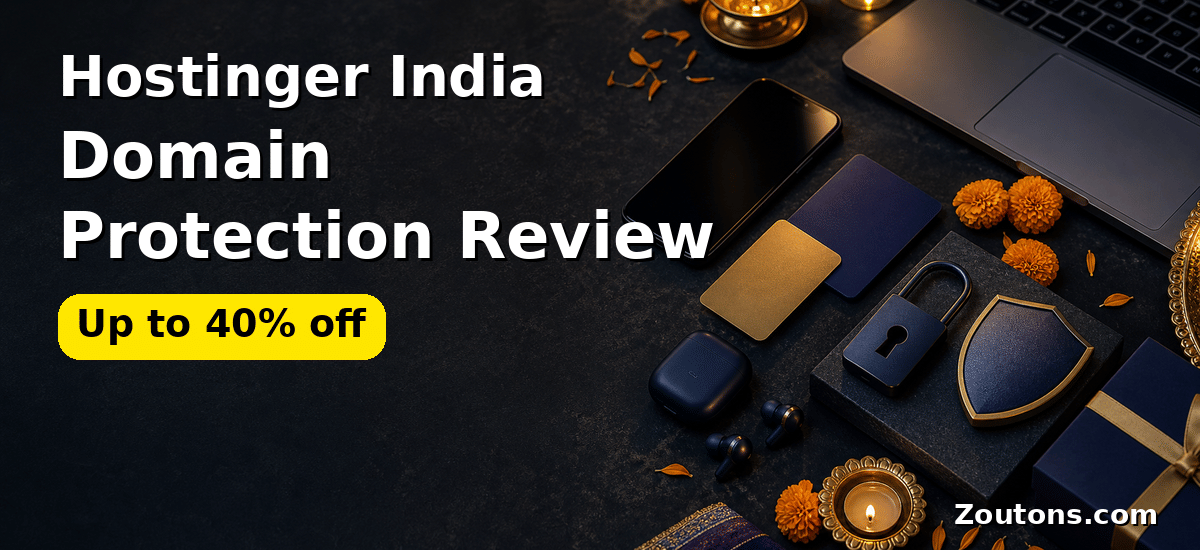
What Hostinger Domain Privacy Actually Does
When you register a domain, ICANN rules require the registrar to collect your real contact details. Without privacy protection, those details — your full name, email, postal address and phone number — are written into the WHOIS record for that domain and are visible to anyone who runs a free WHOIS lookup. Hostinger's Domain Privacy Protection replaces every one of those fields with proxy information owned by the registrar.
After it's turned on, a WHOIS query against your domain shows:
- Registrant name — replaced with "Privacy Protect" or the registrar's proxy name.
- Email — a forwarding alias that filters out scrapers before relaying genuine mail to you.
- Address & phone — the registrar's corporate address, not yours.
- Domain ownership rights — unchanged. You still own and control the domain in full.
When It's Already Free on Hostinger
This is the part most reviews skip. Hostinger has shifted to bundling privacy protection into most of its hosting and domain offers in India, which means a lot of buyers pay zero extra for it. The picture in 2026:
- Most shared web-hosting plans ship with a free domain on annual or longer terms and bundle WHOIS privacy on that domain automatically — you don't have to add it at checkout.
- Domain-only registrations on the most common extensions (.com, .net, .org, .in) include free WHOIS Privacy Protection on Hostinger by default.
- Some country-code TLDs (ccTLDs) — especially regional ones — don't allow privacy at the registry level, so Hostinger can't enable it even if you pay. .in is generally fine; a few niche extensions aren't.
Before you assume you're paying a privacy fee, log into hPanel and check the WHOIS Privacy toggle for the domain — for the vast majority of Indian buyers on a Premium or Business plan, the toggle is already on and the line item costs ₹0.
India Pricing in 2026
For the small set of cases where privacy is a paid add-on — older domains migrated in, certain TLDs, or accounts on the cheapest legacy plans — the line-item cost on Hostinger India sits well below what GoDaddy and BigRock charge for the same feature. Indicative 2026 pricing:
| Scenario | What you pay for privacy | Notes |
|---|---|---|
| New domain on most hosting plans | ₹0 / free | Bundled — already enabled |
| Domain-only registration (.com/.in) | ₹0 / free | Free WHOIS privacy at signup |
| Add-on for an existing domain | ~₹399–₹499/year* | Often discounted heavily on long terms |
| TLDs that don't support privacy | Not available | Registry-level restriction |
*Indicative — confirm the live price at checkout. Coupon codes frequently drop the effective rate further; stack a current Hostinger coupon at checkout to bring the renewal in line with the intro rate where possible.
Hostinger vs GoDaddy vs BigRock vs Namecheap
Privacy protection is one of the clearest places competing registrars differ. Two key questions: is it free, and is it on by default? In 2026 the picture for Indian buyers looks roughly like this:
| Registrar | Price for privacy | On by default? | Notes |
|---|---|---|---|
| Hostinger India | Free on most plans | Yes | Bundled with hosting and most domains |
| Namecheap | Free for life | Yes | Long-standing free WHOIS privacy |
| GoDaddy India | ~₹699–₹999/year | No — paid add-on | Often pre-ticked in cart |
| BigRock | ~₹399–₹599/year | No — paid add-on | Sold as "Privacy Protect" |
If you're already locked in with GoDaddy or BigRock, paying their add-on is still cheaper than ignoring the problem — the spam, calls and phishing that follow a public WHOIS entry quickly cost more than a few hundred rupees a year. But for a new buyer in India, the price-and-default combination on Hostinger and Namecheap is hard to beat.
Who Actually Needs It (and Who Doesn't)
Definitely turn it on:
- Personal blogs, freelancers, solo founders — your home address has no reason to live on a public registry.
- Anyone using their personal mobile as the registrant phone — uncloak it once and the cold-call volume jumps within 48 hours.
- Activists, journalists, or anyone running a politically sensitive site — privacy is the bare minimum, not optional.
- Domain investors / portfolio holders — keep buying interest funnelled through a single contact form, not a leaked email.
You can skip it:
- Registered businesses already showing a public office address and support email on their website — the WHOIS adds no new exposure.
- Some legal/regulated entities that are required to publish verifiable registrant details (rare).
- Domains on TLDs where privacy isn't supported — you have no choice.
Verdict — Is It Worth It?
For a personal site, side project or solo business, yes — and the good news is that on Hostinger India in 2026, you almost certainly don't pay a separate fee for it. The default behaviour is "privacy on, ₹0," which is a meaningful upgrade over GoDaddy and BigRock's tick-box-at-checkout model. The only scenario where it stops being worth the effort is when you already publish your real contact details on your homepage anyway.
If you're moving in from another registrar, check the WHOIS Privacy toggle in hPanel as the very first step after transfer — the migration sometimes lands with it off, and a few hours of public WHOIS exposure is all the spam pipelines need.
Hostinger Domain Protection FAQ
_1776943697.jpg?tr=w-80,h-80,c-force)
Trending
 Flipkart Big Billion Days 2026 Is Live: General Access Open October 9
  Amazon Upcoming Sale Calendar 2026: Next Sale Dates India, GIF & More
  Nykaa Sale Calendar 2026: Diwali Dhamaka & Pink Friday Dates, Next Sale
  Udemy Upcoming Sale 2026: Next Sale Dates, Black Friday & Coupons
  Myntra Sale Calendar 2026: Big Fashion Festival Live Now, Winter EORS Dates
  Amazon Great Indian Festival 2026: Dates Official, Live From Oct 8, SBI 10% Off
 More From Hostinger




 Booking com
  Hostinger
  Dell
Dell  Udemy
Udemy  Agoda
Agoda  Nykaa
Nykaa  Myntra
  Ajio
Ajio