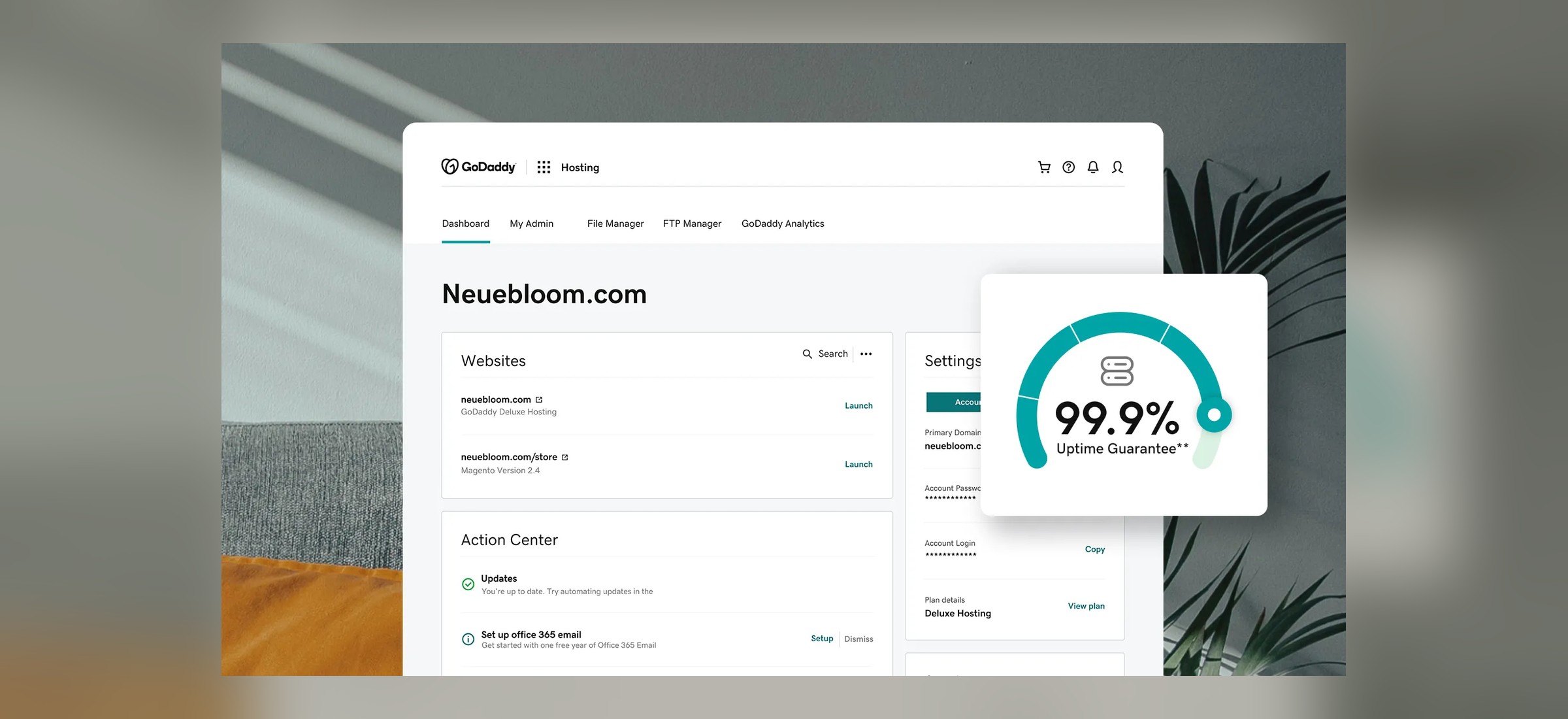
![GoDaddy's own published hosting photograph from its Indian site, showing a hosting control panel on a desktop monitor, used here to illustrate a page about GoDaddy's hosting agreement]()
Hosting is sold on one word, and GoDaddy's hosting contract is unusually willing to define it. We read the Hosting & Security Services Agreement published on its Indian site on 14 October 2026, stamped "Last Revised: 30-09-2026".
It offers "unlimited bandwidth" and "unlimited disk space and websites", and says in terms that "we do not set a limit". A few paragraphs on it sets out the limits — and the sentence that does it begins "All Web Hosting and Managed Hosting for WordPress plans, including the unlimited plans". 100GB of disk. 25% of one CPU core. 512MB of RAM.
Below: all eight published caps in GoDaddy's own numbers, the smaller set that applies to the free trial, the sentence "Our servers are not an archive" and what the agreement says happens to your files when you cancel, what the 99.9% uptime guarantee actually pays, and the size ceiling on migrating a site in. Everything quoted verbatim. This is a description of a published document, not legal advice.
Verbatim, from GoDaddy's Hosting & Security Services Agreement
Read 14 October 2026 on godaddy.com/en-in/legal/agreements/hosting-agreement
"All Web Hosting and Managed Hosting for WordPress plans, including the unlimited plans, are subject to a limit of no more than 2,50,000 inodes per account for Linux hosting accounts or 5,00,000 files and folders per account for Windows hosting accounts, and all plans are limited to no more than 100GB of disk storage."
📅 Update log:
14 October 2026 — First publication. GoDaddy's Hosting & Security Services Agreement read in full from godaddy.com/en-in/legal/agreements/hosting-agreement, logged out, in India, nothing bought and no account opened. Document stamped "Last Revised: 30-09-2026"; 228 sentences over 45 characters. Captured and quoted: the unlimited-bandwidth and no-limit sentences; the "including the unlimited plans" cap sentence with the inode, files-and-folders and 100GB disk figures; the per-database table and gigabyte caps; the network-violation and suspension consequence; the Linux CPU, RAM, connection, process and disk IO limits and the slowdown consequence; the Managed WordPress non-WordPress-site suspension clause; the complete free-trial limit list including the 10GB bandwidth figure; the risk-to-stability VPS-upgrade clause; the cPanel Fair Usage Policy 100-account guideline and the comparison-to-other-users evaluation sentence; the excess-usage notice undertaking; the "Our servers are not an archive" sentence and the no-liability clause attached to it; the customer backup responsibility clause; the pre-termination content-removal duty, the no-FTP-transfer sentence and the deletion-with-no-copy sentence; the 10-day backup snapshot cycle; the backup-cancelled-with-plan clause; the 99.9% Service Uptime Guarantee, the 5% credit, the "as solely determined by us" qualifier, the credit-only-for-further-purchases restriction and all five exclusions; the 10GB / 1,00,000 file migration ceiling, the no-backup-on-migration clause and the no-liability-for-data-loss clause; the licensed images on export clause; the content removal, malware scanning, support-may-modify and minimum-technical-requirements clauses. No price, plan cost or coupon code is asserted anywhere on this page. Content verified 14 October 2026.
What "unlimited" means in GoDaddy's own hosting agreement
GoDaddy's Hosting & Security Services Agreement is the contract that sits under a web hosting, WordPress or VPS plan. We read the version published on its Indian site on 14 October 2026. It is stamped "Last Revised: 30-09-2026".
The agreement offers unlimited hosting in plain terms: "we offer unlimited bandwidth and some plans offer unlimited disk space and websites", and "This means that we do not set a limit on the amount of bandwidth, websites or disk space you may use in the operation of your website".
A few paragraphs later it sets out the limits. The sentence that does the work contains the phrase "including the unlimited plans" — the caps are written to apply to the plans sold as uncapped, and the document says so itself rather than leaving it to be inferred.
Verbatim, from GoDaddy's Hosting & Security Services Agreement, read 14 October 2026: "All Web Hosting and Managed Hosting for WordPress plans, including the unlimited plans, are subject to a limit of no more than 2,50,000 inodes per account for Linux® hosting accounts or 5,00,000 files and folders per account for Windows® hosting accounts, and all plans are limited to no more than 100GB of disk storage."
Every published cap, in the agreement's own numbers
| What is capped | The agreement's wording | What it means in practice |
|---|
| Disk storage | "all plans are limited to no more than 100GB of disk storage" | Applies to the unlimited plans by its own wording |
| Inodes (Linux) | "no more than 2,50,000 inodes per account for Linux® hosting accounts" | An inode is roughly one file or folder |
| Files and folders (Windows) | "5,00,000 files and folders per account for Windows® hosting accounts" | The Windows equivalent of the inode cap |
| Database size | "no more than 1,000 tables per database and no more than one gigabyte of storage per database" | Per database, not per account |
| CPU | "no more than a) 25% of one CPU core" | A quarter of a single core, on Linux plans |
| Memory | "b) 512MB of RAM" | Half a gigabyte |
| Concurrent connections | "c) 100 website connections; d) 100 active processes" | Visitors being served at the same moment |
| Disk throughput | "e) 1 MB/s disk IO" | Read/write speed available to the account |
Read the CPU and memory lines together. A Linux hosting plan is entitled to a quarter of one CPU core and 512MB of RAM, and the agreement states the consequence directly: "In the event these limitations are exceeded, your site may slow down or not be served until more resources are added."
The storage caps carry a different consequence. An account over the inode, file, table or gigabyte limits "may be issued a network violation warning and will be required to reduce the number of inodes, files and folders, tables or gigabytes (as the case may be), or may be temporarily or permanently suspended, in our sole discretion".
There is a separate rule for WordPress plans that has nothing to do with resources at all: "Any Managed Hosting for WordPress account found to be hosting a non-WordPress website may be issued a network violation warning… or may be temporarily or permanently suspended, in our sole discretion."
Credit where it is due. A great many hosts stop at the words "fair use" and never publish a number. GoDaddy publishes eight of them, in the contract, where they can be read before you buy. That is the useful thing about this document.
The free trial has its own, smaller set of numbers
| What is capped | The agreement's wording | Against the paid plan |
|---|
| CPU | "25% of one CPU core" | Same as the paid Linux plans |
| RAM | "256MB of RAM" | Half the paid allowance |
| Website connections | "10 website connections" | A tenth of the paid allowance |
| Disk IO | ".5 MB/s disk IO" | Half the paid throughput |
| Inodes | "50,000 inodes" | A fifth of the paid cap |
| Disk space | "1 GB diskspace" | Against 100GB on paid plans |
| Bandwidth | "10 GB monthly bandwidth" | The only bandwidth number in the agreement |
The free trial is the only place in the agreement where a bandwidth figure appears at all — "10 GB monthly bandwidth". On the paid plans bandwidth is described as unlimited and no number is given, though the agreement reserves the right to act if usage "presents a risk to the stability, performance or uptime of our servers", in which case "you may be required to upgrade to a VPS, or we may take action to restrict the resources your website is utilizing".
The cPanel VPS product has a third regime again, and it is candid about being a judgement call: "VPS with cPanel offers unlimited number of accounts… Although we do not wish to set a specific limit, as a guideline, a threshold of 100 accounts will be considered normal, reasonable use." How that is assessed is stated too: "We evaluate your usage in comparison to typical levels of usage engaged in by other users."
"Our servers are not an archive"
That is a direct quotation, and it is the single most practically important sentence in the document. The full line reads: "Our servers are not an archive and we shall have no liability to you or any other person for loss, damage or destruction of any of your content."
The agreement puts the backup duty on the customer in terms: you are "solely responsible for undertaking measures to: (1) prevent any loss or damage to your website or server content; (2) maintain independent archival and backup copies of your website or server content".
What happens at the end of the relationship is set out just as plainly, and it is the part worth acting on before you ever need it:
On cancellation, verbatim: "Prior to termination of the Hosting Services, you are responsible for moving your website or server content off our servers. We will not transfer or FTP your website or server content to another provider. If you fail to move your website or server content off our servers prior to cancellation, we will delete all such content and we will not be able to provide a copy of such content."
Note the two halves. GoDaddy will not move your files out for you, and if you leave without moving them yourself, the agreement says they go and no copy can be produced afterwards. The cheap precaution is an independent backup you hold yourself, taken before you cancel anything — which is exactly what the agreement asks for anyway.
Where backups are included with a support plan, the agreement states the interval: "The backups offered with these support plans are snapshots taken on a 10-day cycle." And hosting backup services "will be cancelled if the Hosting subscription plan is cancelled".
The 99.9% uptime guarantee, and what it actually pays
The agreement offers "a Service uptime guarantee of 99.9%… of available time per month". Three qualifications follow in the same breath.
You have to ask. "If we fail to maintain this Service Uptime Guarantee in a particular month (as solely determined by us), you may contact us and request a credit of 5% of your monthly hosting fee for that month." It is not automatic, and whether the guarantee was missed is "as solely determined by us".
It is a credit, not money. "The credit may be used only for the purchase of further products and services from us, and is exclusive of any applicable taxes." On a Rs. 299 monthly plan, 5% is roughly Rs. 15 of store credit.
And the exclusions are wide. The guarantee does not cover "outages that do not affect the appearance of your website but merely affect access to your website such as FTP and email", nor interruptions caused by your own "custom scripting, coding or the installation of third-party applications", nor scheduled maintenance.
Moving in: migration has a published ceiling
GoDaddy will attempt to migrate a site from another host "at your request and in our sole discretion", but the agreement names the point at which the service stops being offered: "Hosting Migrations are not available for websites with over 10GB of data or more than 1,00,000 files."
It also declines the backup during the move — "We will not perform website backups or archives in connection with a Hosting Migration, and we recommend that you back up your third-party hosted website before migration to ensure that no data is lost" — and disclaims the outcome: "You agree that we are not liable for any delay in website resolution or loss of data related to your Hosting Migration."
One further clause is easy to miss and matters if you ever leave. Images licensed through GoDaddy "are intended for GoDaddy hosted customers only", and on export "it is solely your responsibility to ensure your continued right to use any images incorporated therein". A site that moves may be carrying pictures whose licence did not move with it.
What else the agreement reserves
Content removal. "we reserve the right to remove your server, website, or any content temporarily or permanently if you are in violation of this Service Agreement or if your server, website, or other content threatens the stability of our network or create risk to GoDaddy or its other customers."
Scanning. "GoDaddy reserves the right to scan your hosted account for malicious content (e.g., malware)" and may then "take whatever steps it deems reasonably necessary to mitigate or remediate any security threat".
Support touching your site. "in the course of providing you with technical assistance, it may be necessary for our support staff to modify, alter or remove the content of your hosted product."
Technical requirements you must keep up with. Where you fail to meet or upgrade to minimum technical requirements "as determined by GoDaddy in its sole discretion", GoDaddy "reserves the right to limit, mo[dify]" the service, and "shall not be held liable for any disruption or loss of service resulting from your failure to do so."
We are reporting what the document says, and stopping there. Whether any of these clauses is valid, binding, fair or enforceable is a question for a court or a regulator and not for a shopping guide. Nothing on this page is legal advice, and nothing here limits any statutory right you have, which applies regardless of what a contract says.
Frequently Asked Questions
Is GoDaddy's unlimited hosting really unlimited?
The agreement says both things, and the limits are written to apply to the unlimited plans. It offers "unlimited bandwidth" and says "we do not set a limit on the amount of bandwidth, websites or disk space you may use". It then states: "All Web Hosting and Managed Hosting for WordPress plans, including the unlimited plans, are subject to a limit of no more than 2,50,000 inodes per account for Linux® hosting accounts or 5,00,000 files and folders per account for Windows® hosting accounts, and all plans are limited to no more than 100GB of disk storage." Bandwidth is the one thing with no number attached on paid plans — though usage that "presents a risk to the stability, performance or uptime of our servers" may mean "you may be required to upgrade to a VPS". Quoted verbatim from the version read 14 October 2026.
How much CPU and RAM does a GoDaddy shared hosting plan get?
The agreement prints the figures: "All Linux hosting plans are subject to the following limitations: no more than a) 25% of one CPU core; b) 512MB of RAM; c) 100 website connections; d) 100 active processes; e) 1 MB/s disk IO." A quarter of a single core and half a gigabyte of memory. The stated consequence of going over is not a bill but a slowdown: "In the event these limitations are exceeded, your site may slow down or not be served until more resources are added." The free trial gets the same CPU share but "256MB of RAM", "10 website connections" and "10 GB monthly bandwidth".
What happens to my website files if I cancel GoDaddy hosting?
The agreement is explicit, and it is worth acting on before you cancel rather than after. "Prior to termination of the Hosting Services, you are responsible for moving your website or server content off our servers. We will not transfer or FTP your website or server content to another provider. If you fail to move your website or server content off our servers prior to cancellation, we will delete all such content and we will not be able to provide a copy of such content." Elsewhere it states: "Our servers are not an archive and we shall have no liability to you or any other person for loss, damage or destruction of any of your content." Take your own backup before you touch the cancel button. Backups bundled with a hosting plan are also cancelled with it, and where included under a support plan they are "snapshots taken on a 10-day cycle".
What does GoDaddy's 99.9% uptime guarantee actually pay out?
Five per cent of one month's hosting fee, as store credit, if you ask for it. "If we fail to maintain this Service Uptime Guarantee in a particular month (as solely determined by us), you may contact us and request a credit of 5% of your monthly hosting fee for that month." The credit "may be used only for the purchase of further products and services from us". Three things follow from the wording: it is not automatic, whether the guarantee was missed is "as solely determined by us", and the exclusions are broad — it does not cover scheduled maintenance, problems caused by your own "custom scripting, coding or the installation of third-party applications", or "outages that do not affect the appearance of your website but merely affect access to your website such as FTP and email".
Will GoDaddy migrate my existing website for me?
It may, at its discretion, and there is a published size ceiling. Migration is offered "at your request and in our sole discretion", and "Hosting Migrations are not available for websites with over 10GB of data or more than 1,00,000 files." GoDaddy does not back the site up as part of the move — "We will not perform website backups or archives in connection with a Hosting Migration, and we recommend that you back up your third-party hosted website before migration" — and "You agree that we are not liable for any delay in website resolution or loss of data related to your Hosting Migration." The agreement also warns that some hosts "save data in an incompatible or proprietary format", which may make the transfer impossible, and that after migrating you are "solely responsible for reviewing the functionality and accuracy of migrated content".
Prices & codes last verified: October 14, 2026
Zoutons may earn a commission when you buy through links on this page. Every quotation on this page is GoDaddy's own published text, read on 14 October 2026 from godaddy.com/en-in/legal/agreements/hosting-agreement, logged out, in India, with nothing bought, no account opened, no service cancelled, no migration requested, no uptime credit claimed and GoDaddy not contacted. Quotations are reproduced verbatim, including the source's own capitalisation, numerals, spacing and punctuation — including its Indian digit grouping such as "2,50,000" and "1,00,000" — and any emphasis is ours. This page describes what one published document says. It is a summary for general information, it is not legal, technical, tax or financial advice, and it must not be relied on as a statement of your contractual or statutory rights. Nothing on this page assesses whether any clause described is valid, binding, fair or enforceable, and nothing here tells any reader what their own legal status is. In particular, reporting that a contract describes a plan as 'unlimited' and elsewhere states numerical caps applying to that plan is a description of the document's own wording and is expressly not a statement that any advertisement, plan description or representation is false, misleading, deceptive, unfair or non-compliant, nor that any limit is unreasonable or improperly applied. Whether a contractual term or a product description has legal effect is a matter for a court or a regulator. Statutory consumer rights apply to a transaction regardless of what any contract document says, and nothing on this page limits them or purports to. Nothing on this page alleges or implies any wrongdoing, misleading advertisement, unfair contract term, dark pattern, service deficiency, non-compliance or breach of law by GoDaddy.com, LLC, GoDaddy India Domains and Hosting Services India Pvt Ltd, any GoDaddy affiliate, or by cPanel, Acronis, Norton or any other third party named in the agreement. A business is generally free to set the terms on which it sells and to define the resources attached to a plan, and publishing specific numerical limits openly in the contract, as GoDaddy does here, is an ordinary and proper commercial act and is more informative than the undefined 'fair use' language common elsewhere in the industry. The document was read as text, which flattens its tables, lists and footnotes and may omit structure; it incorporates other agreements and policies by reference that are not reproduced here, including the Universal Terms of Service, the Refund Policy, the Privacy Policy and product-specific terms, and any of those may qualify or override what is described here for a particular product. Limits, guarantees and thresholds may differ between plans, data centres, operating systems and regions, and the figures quoted are those the agreement attaches to the plan types it names. We have not purchased, provisioned, benchmarked, load-tested or measured any GoDaddy hosting plan, have not exceeded any limit, requested any migration, claimed any uptime credit, cancelled any service or had any account suspended, and we make no representation about the performance any plan delivers in practice or about how GoDaddy would act in any particular case. No price, plan cost, renewal rate, fee or coupon code is asserted anywhere on this page. Legal agreements, their revision stamps and their contents change without notice and may already differ from what is described here; the version published on godaddy.com at the time you read it prevails over anything on this page, and you should read the version that applies to your own account, and take your own advice, before acting.













 Booking com
  Hostinger
  Dell
Dell  Udemy
Udemy  Agoda
Agoda  Nykaa
Nykaa  Myntra
  Ajio
Ajio