Amazon Prime Day 2026 No-Cost EMI: Cards, Tenures, Stacking Rules

Prime Day 2026 Edition
Amazon Prime Day 2026 No-Cost EMI — The Complete Playbook
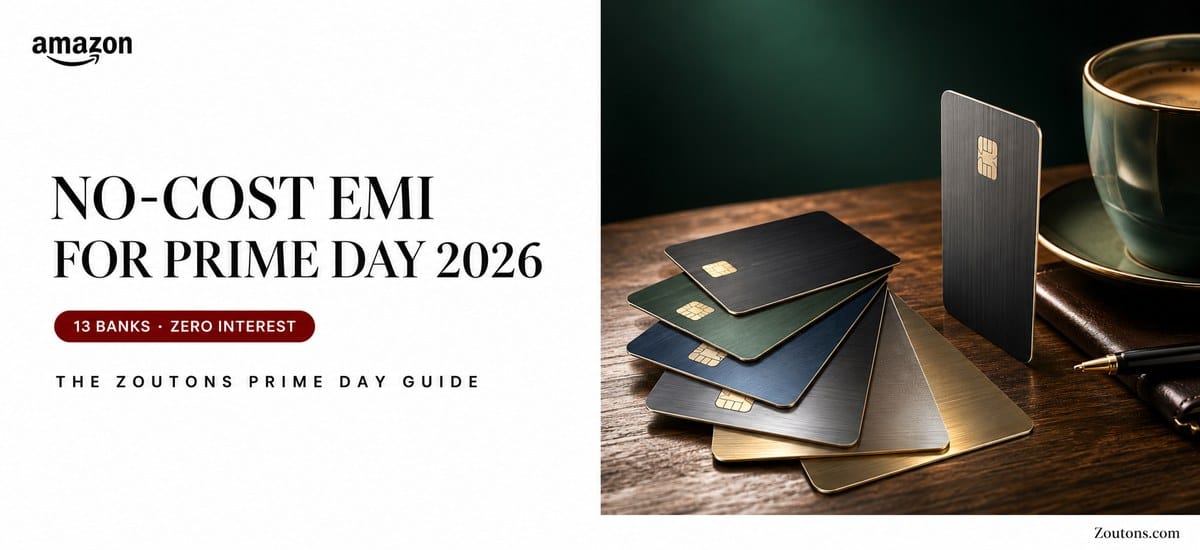
Thirteen banks, four tenure options, six hidden gotchas, one perfect stack. The complete No-Cost EMI guide for Prime Day 2026 — including whether you can layer it on the 10% bank offer.
No-Cost EMI is the single most-used affordability feature on Amazon India Prime Day. Roughly one in every three purchases above ₹10,000 during the last three Prime Day editions converted to a No-Cost EMI at checkout. The mechanic is straightforward on the surface — spread a big purchase over 3-12 monthly instalments with zero interest — but the fine print has meaningful nuance most shoppers miss.
This guide covers the entire Prime Day 2026 No-Cost EMI landscape: which 13 banks offer it, the exact minimum cart values and tenure options for each, how it stacks with the 10% instant discount from the same bank's flagship-sale offer, the six hidden gotchas (processing fees, foreclosure charges, credit-utilisation impact, return-refund quirks), and the ranked verdict on when to use it and when to skip it.
How No-Cost EMI Actually Works
The mechanics behind Amazon's headline 'zero interest' claim — and where the real cost hides.
No-Cost EMI (also called Zero-Cost EMI or Equated Monthly Instalment) is Amazon India's flagship affordability programme, letting shoppers convert single purchases into interest-free monthly instalments. The name is technically accurate — the interest charge you'd normally pay on an EMI is absorbed by the merchant (Amazon or the brand). But the mechanic has nuance most shoppers miss.
How the transaction actually breaks down:
- You add a product priced at ₹30,000 to your cart
- At checkout, you select "No-Cost EMI" from the payment options and pick your bank + tenure (3, 6, 9, or 12 months)
- The bank you selected charges your credit card for the full ₹30,000 immediately — this appears on your statement
- Simultaneously, Amazon adds a "cashback" line item worth the equivalent interest amount (typically ₹1,500-₹2,500 depending on tenure) to your Amazon account
- Your card is billed for the ₹30,000 in monthly instalments of ~₹2,500 (for 12 months) as tracked by your bank
- Each month, when the bank charges its interest portion, Amazon's pre-issued cashback offsets it — resulting in a net-zero interest charge to you
The three components of the cost that are actually being covered:
- Bank interest (the visible one): The 12-16% p.a. interest the bank would normally charge on a personal EMI. This is what No-Cost EMI eliminates.
- Processing fee (usually ₹99-₹299): The upfront charge from the bank for setting up the EMI. Some No-Cost EMI offers waive this; many don't.
- GST on interest (18%): Even in a no-cost programme, GST on the notional interest amount can be charged. Amazon typically absorbs this too during flagship sales but check the specific offer.
Which Banks Offer No-Cost EMI on Amazon Prime Day 2026
The complete list of banks with Amazon No-Cost EMI, minimum tenure requirements, and processing fees.
Amazon India supports No-Cost EMI across most major Indian credit card issuers, plus several debit card programmes and dedicated BNPL products. The specific tenure and minimum-cart-value thresholds vary by bank.
Credit card No-Cost EMI (expected for Prime Day 2026):
| Bank | Min Cart Value | Tenures Available | Processing Fee |
|---|---|---|---|
| HDFC Bank | ₹3,000 (Prime), ₹5,000 (non-Prime) | 3, 6, 9, 12, 18, 24 months | ₹199 (waived on Prime Day) |
| SBI Card | ₹5,000 | 3, 6, 9, 12 months | ₹99-₹199 (typically waived Prime Day) |
| ICICI Bank | ₹3,000 | 3, 6, 9, 12 months | Free (waived automatically) |
| Axis Bank | ₹5,000 | 3, 6, 9, 12 months | ₹99 |
| Kotak Mahindra | ₹5,000 | 3, 6, 9, 12 months | ₹149 |
| Standard Chartered | ₹6,000 | 3, 6, 9, 12 months | ₹199 |
| Amex | ₹10,000 | 3, 6, 9, 12, 18 months | Free for Platinum+ |
| RBL Bank | ₹5,000 | 3, 6, 9, 12 months | ₹199 |
| Yes Bank | ₹5,000 | 3, 6, 9 months | ₹99 |
| IndusInd | ₹5,000 | 3, 6, 9, 12 months | ₹149 |
| IDFC First | ₹5,000 | 3, 6, 9, 12 months | Free |
| Bank of Baroda | ₹5,000 | 3, 6, 9 months | ₹99 |
| Federal Bank | ₹5,000 | 3, 6, 9, 12 months | ₹99 |
Debit card No-Cost EMI (expected for Prime Day 2026):
- HDFC Debit EMI: Available on select premium accounts (Preferred / Imperia); minimum ₹8,000 cart
- SBI YONO Debit EMI: Minimum ₹8,000 cart, up to 12-month tenure
- ICICI Debit EMI: Minimum ₹8,000 cart, subject to bank pre-approval; check via ICICI iMobile app
- Kotak Debit EMI: Minimum ₹10,000 cart
- Federal Debit EMI: Minimum ₹8,000 cart, tenures 3-9 months
BNPL and pay-later products:
- Amazon Pay Later: Amazon's own BNPL (₹0 down, 3-9 month tenure, no processing fee) — application takes 2-5 mins
- ZestMoney (discontinued 2024): No longer available in India
- Simpl Pay Later: Available at Amazon India for cart <₹10,000; 15-day interest-free window then rolls to EMI
- LazyPay: Available at Amazon India for cart <₹15,000; 15-day interest-free rolling window
Stacking No-Cost EMI with Prime Day Bank Offers
Whether you can layer the 10% instant discount from the same bank's card that's providing the EMI.
The single most-asked question about Amazon Prime Day EMI: can you stack the 10% instant discount from your bank card on the same card providing the No-Cost EMI conversion?
Short answer: Yes, in almost all cases.
The 10% instant discount is a merchant-level discount applied at checkout, before the EMI conversion is processed. The EMI conversion happens at the payment step — after the checkout price has already been reduced. The bank's interest waiver applies to whatever the final billed amount is (post-instant-discount), not the pre-discount amount.
Worked example — ₹40,000 laptop on Prime Day 2026:
| Step | Amount | Notes |
|---|---|---|
| Sticker price at checkout | ₹40,000 | After Prime Day discount |
| Amazon coupon (if any) | -₹500 | Applied to cart |
| Sub-total after coupon | ₹39,500 | |
| SBI 10% instant discount (capped) | -₹1,500 | Applied at payment step |
| Net billed to card | ₹38,000 | Card is charged this amount |
| EMI conversion (12 months, ₹3,167/mo) | -₹0 interest | Bank normally would charge ~₹2,850 interest; Amazon absorbs this via cashback |
| Processing fee | -₹199 | Amazon typically waives this during Prime Day |
| Amazon Pay cashback (SBI Amazon Pay card only) | -₹1,900 | 5% of ₹38,000, credited post-purchase |
| Total effective spend over 12 months | ₹36,100 | vs ₹40,000 sticker = ₹3,900 saved |
When No-Cost EMI Actually Makes Sense
The specific cart types where converting to EMI is smart — and when to skip it.
No-Cost EMI is a genuinely good financial product when used correctly, but it's not always the right choice.
When to use No-Cost EMI:
- High-ticket single purchases (₹15,000+): The cash-flow benefit of spreading over 6-12 months without interest is genuine
- You would have bought the item anyway: Not induced spending — an item you needed and researched
- Your credit card is your only high-limit payment method: If your card limit is ₹30,000 and you buy a ₹28,000 item outright, you're stuck for the month. EMI conversion frees the limit for other purchases
- You have zero-interest deployment for your cash: If your cash is in a 7-8% savings account, keeping it there and using EMI is a small net positive
When to SKIP No-Cost EMI:
- Small purchases (under ₹5,000): The processing fee eats most of the benefit
- You have the cash and it's earning >8% in fixed deposits/mutual funds: Paying cash is close to net-neutral, and simpler
- The product might be returned: Reversing an EMI conversion is a 30-day process with the bank; refunds may be split back over the EMI schedule
- You already carry a credit-card balance: The EMI is a new liability on top of what you're paying interest on already — the "no cost" applies only to the EMI transaction, not to your carried balance
- The item's launch price is likely to drop: New iPhone launches, high-demand games — the item is worth less in 6 months, and you're locked into paying the launch price
The Verdict — Best No-Cost EMI Strategy for Prime Day 2026
A ranked playbook for using No-Cost EMI right during Prime Day 2026.
Consolidated strategy for making No-Cost EMI work for Prime Day 2026:
- Choose a card that stacks with the 10% instant discount — SBI Amazon Pay or Amazon Pay ICICI both stack. If you don't have one of these, apply 2 weeks before Prime Day 2026
- Target 6-month tenure over 12-month — Shorter tenure means less exposure to bank policy changes and refund complications. Interest saved is identical for the customer either way
- Only convert purchases you'd make anyway — EMI is a cash-flow tool, not a discount tool. Do not let it induce buying
- Stick to purchases above ₹10,000 — Below that, processing fees and small monthly amounts create more friction than benefit
- Set the credit card to auto-debit FULL amount — Prevents the interest-free portion from being treated as revolving credit
- Do not pre-close — Foreclosure fees are 3-5%. Let the EMI run its full tenure
- Verify the offer is on flagship-sale eligible categories — Some categories (jewellery, watches over ₹50,000) may exclude the no-cost portion during Prime Day
Done right, No-Cost EMI on Prime Day 2026 turns a ₹30,000-₹50,000 purchase into 6-12 months of ₹2,500-₹5,000 monthly cash flow at effectively zero interest — a cleaner cash-management play than personal loans, credit-card revolving credit, or dipping into savings.
Frequently asked questions
Is No-Cost EMI on Amazon really no cost?
Yes, when the offer runs as advertised. The interest amount you'd normally pay on an EMI is subsidised by Amazon and the brand — you pay only the original product price divided over the chosen tenure. Watch for: processing fees (usually ₹99-₹299, sometimes waived; sometimes reimbursed as cashback), GST on the notional interest (typically absorbed during flagship sales), and foreclosure charges if you pre-pay early.
Can I use No-Cost EMI with the Prime Day 10% instant discount?
Yes for most cards. The 10% instant discount applies at the checkout stage, reducing the effective cart price. The EMI conversion then applies to the reduced amount. Confirmed stacking: SBI Amazon Pay Credit Card, Amazon Pay ICICI Card, HDFC Millennia. Check the specific offer T&C on the Prime Day 2026 landing page for exclusions.
Which bank offers the best No-Cost EMI on Amazon Prime Day 2026?
For lowest total cost including fees: ICICI Bank (₹0 processing fee, ₹3,000 minimum cart) and IDFC First (₹0 processing fee, ₹5,000 minimum). For maximum tenure flexibility: HDFC Bank offers 3, 6, 9, 12, 18, and 24-month options. For the highest stacking value: Amazon Pay ICICI Credit Card or SBI Amazon Pay Card — both include the 10% instant discount plus 5% cashback plus the No-Cost EMI conversion.
What happens if I return a No-Cost EMI purchase?
The refund is processed against the EMI. Depending on the bank: (a) HDFC, SBI, ICICI reverse the total amount as a lump refund credited to the card, closing the EMI; (b) Axis and Kotak reverse each remaining instalment individually over the EMI schedule; (c) some smaller banks require you to close the EMI manually via bank support after the refund is credited. Confirm with the specific card issuer before returning.
Is there a maximum tenure for Amazon No-Cost EMI?
Yes, capped by the bank. Most banks offer 3, 6, 9, and 12-month tenures on No-Cost EMI. HDFC extends to 18 and 24 months on select categories (typically premium electronics and appliances above ₹40,000). Longer tenures reduce monthly outflow but increase exposure to policy changes and refund complications. We recommend 6-month tenure for most purchases.
All bank tenure and processing-fee details verified against the live No-Cost EMI landing pages of HDFC, SBI, ICICI, Axis, Kotak, Standard Chartered, and Amex on 5 July 2026. Prime Day 2026 specific offers will be published on the Amazon Prime Day landing page 5-7 days before the sale opens; this page will refresh within 24 hours.