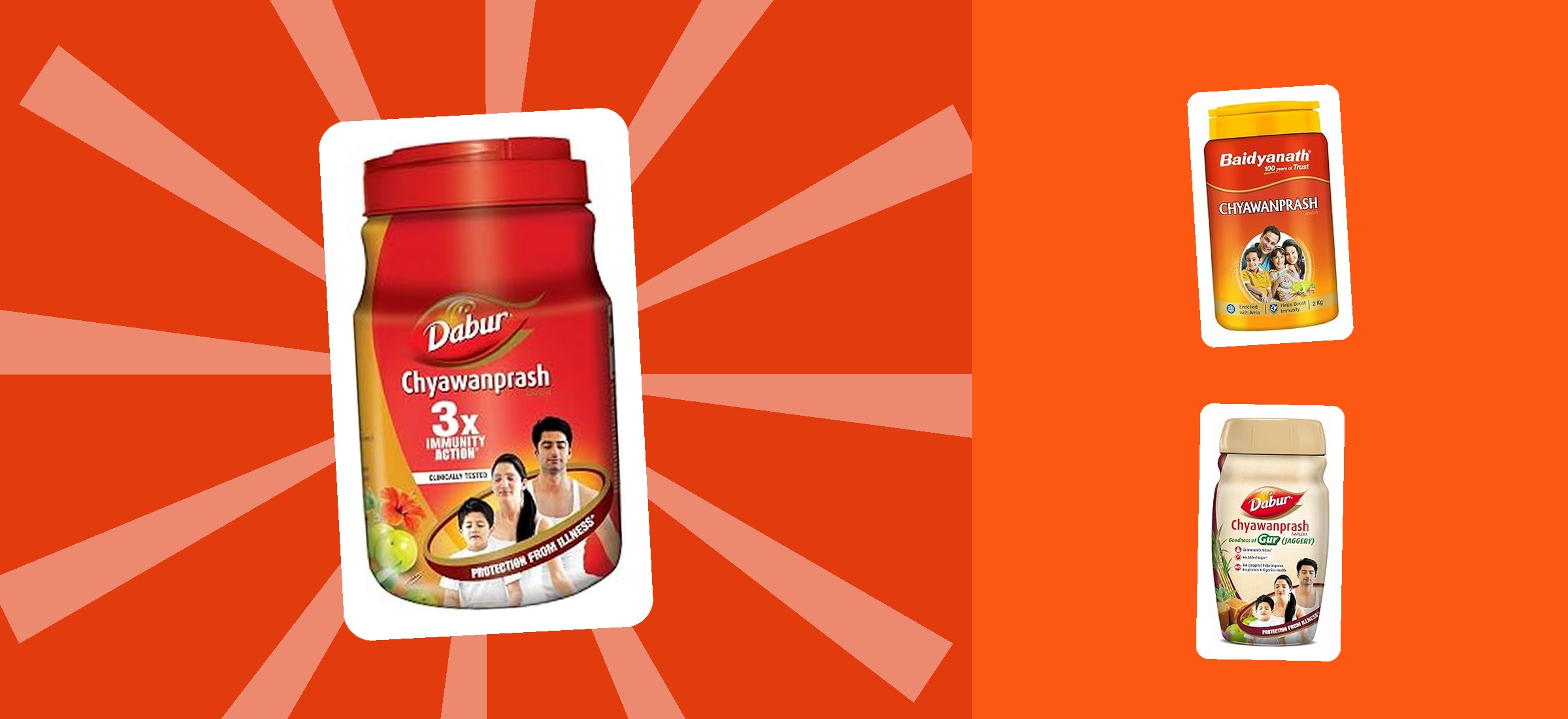
![Three chyawanprash jars - Dabur, Baidyanath and Dabur Jaggery - on an orange colour-blocked banner, from the Amazon shelf this page priced on 28 November 2026]()
The small second number on an Amazon chyawanprash tile is not an MRP - it is the price per 100 grams. We read the shelf on 28 November 2026 and tested it: multiply that figure by the pack weight in the title and it matches the asking price on 14 of 15 tiles, within 0.0% to 4.0%. So no honest discount can be computed from it, and this page computes none. What does vary is the real unit cost: Rs. 18.5 to Rs. 79.9 per 100g, a 4.32x spread. And the big-jar saving is brand-specific - 1.95x at Baidyanath, 1.01x at Dabur.
📅 Update log:
28 November 2026: first published. Read on this date from an Indian IP, logged out, with nothing bought, from amazon.in search results for "chyawanprash". 30 tiles returned; 15 are chyawanprash with a pack weight stated in the title and all 15 carry a rating. Pack prices Rs. 90 to Rs. 719, median Rs. 325. Per 100g Rs. 18.5 to Rs. 79.9, median Rs. 33.7, a 4.32x spread. The second printed figure reconciles as a per-100g rate on 14 of 15 tiles, deviations 0.0% to 4.0%; the fifteenth prints Rs. 249 against a Rs. 249 price and shows no rate. Baidyanath 250 g costs 1.95x its own 2 kg per 100g; Dabur 950 g costs 1.01x its 2 kg. Baidyanath's 2 kg and 1 kg both report 4.1 from exactly 389 reviews. Every figure is Amazon's own printed number on that date and may have changed since.
That second number is not an MRP. It is the price per 100 grams.
We read Amazon's chyawanprash shelf on 28 November 2026: 30 tiles returned, of which 15 are chyawanprash with a pack weight stated in the title. Every one of the 15 carries a rating.
Each tile prints a second, much smaller figure beside the price. It looks like an MRP and it is not. Multiply it by the pack weight in the title and it reconciles with the asking price on 14 of the 15 tiles, with deviations of 0.0% to 4.0%. Rs. 18 per 100g across 2,000 g gives Rs. 360 against Rs. 370 asked. Rs. 30 across 500 g gives Rs. 150 against Rs. 150 asked. Rs. 79 across 900 g gives Rs. 711 against Rs. 719 asked.
That matters because a discount computed from it would be pure fiction - it would report a Rs. 370 jar as being 95% off a Rs. 18 "MRP". This page therefore publishes no discount percentage for this shelf at all. The one tile that breaks the pattern prints Rs. 249 against a Rs. 249 price: its own selling price in the rate slot, and no rate.
| Listing | Per 100g | Stated pack | Pack price | Figure Amazon prints | Reconciliation gap |
|---|
| Baidyanath Ayurved Chyawanprash 2 KG | Rs. 18.5 | 2,000 g | Rs. 370 | Rs. 18 | 2.7% |
| Baidyanath Ayurved Chyawanprash 1 KG | Rs. 19.4 | 1,000 g | Rs. 194 | Rs. 19 | 2.1% |
| Baidyanath Chyawanprash Special Pack 2.4 kg | Rs. 20.8 | 2,400 g | Rs. 500 | Rs. 20 | 4.0% |
| Baidyanath Sugarfree Chywanprash 1 kg | Rs. 26.2 | 1,000 g | Rs. 262 | Rs. 26 | 0.8% |
| Baidyanath Asli Ayurved Special 950 g | Rs. 26.2 | 950 g | Rs. 249 | Rs. 249 - no rate printed | n/a |
| Baidyanath Asli Ayurved Special 500 g | Rs. 30.0 | 500 g | Rs. 150 | Rs. 30 | 0.0% |
| Dabur Chyawanprash Awaleha 900 g | Rs. 32.6 | 900 g | Rs. 293 | Rs. 32 | 1.7% |
| Patanjali Special Chyawanprash 1 KG | Rs. 33.7 | 1,000 g | Rs. 337 | Rs. 33 | 2.1% |
| Dabur Chyawanprash 2 kg | Rs. 34.4 | 2,000 g | Rs. 688 | Rs. 34 | 1.2% |
| Dabur Chyawanprash 950 g | Rs. 34.9 | 950 g | Rs. 332 | Rs. 34 | 2.7% |
| Zandu Chyavanprash Jaggery 910 g | Rs. 35.7 | 910 g | Rs. 325 | Rs. 36 | 0.8% |
| Baidyanath Asli Avaleha 250 g | Rs. 36.0 | 250 g | Rs. 90 | Rs. 36 | 0.0% |
| Kottakkal Arya Vaidya Sala Chyavanaprasam 500 g | Rs. 59.8 | 500 g | Rs. 299 | Rs. 59 | 1.3% |
| Jeena Sikho Chyawanprash 500 g | Rs. 67.6 | 500 g | Rs. 338 | Rs. 67 | 0.9% |
| Zandu Kesari Jivan Chyawanprash 900 g | Rs. 79.9 | 900 g | Rs. 719 | Rs. 79 | 1.1% |
How to test this yourself on any grocery tile. Take the small second figure, multiply by the pack weight in the title, divide by 100. If the answer lands within a few per cent of the asking price, it is a unit rate and not a list price - and no discount can honestly be computed from it.
A 4.32x spread in what 100 grams costs - and a pack penalty that only one brand charges
Pack prices on this shelf run Rs. 90 to Rs. 719, but the jars run 250 g to 2.4 kg, so that range says almost nothing. Per 100g the shelf runs Rs. 18.5 to Rs. 79.9 with a median of Rs. 33.7 - a 4.32x spread between the cheapest and dearest hundred grams of chyawanprash on one screen.
The usual advice is to buy the biggest jar. At Baidyanath that advice is worth roughly half the unit price: its 2 kg works out at Rs. 18.5 per 100g and its own 250 g at Rs. 36.0 - 1.95 times as much for the same brand.
At Dabur it is worth almost nothing. The 2 kg is Rs. 34.4 per 100g and the 950 g is Rs. 34.9 - a gap of 1.5%. A shopper who buys a 2 kg Dabur jar to save money per gram has saved about fifty paise per hundred grams. The penalty is a brand pricing decision, not a rule of the category, and the only way to see it is to divide.
| Listing | Pack price | Stated pack | Per 100g | Against that brand's largest jar |
|---|
| Baidyanath 2 kg | Rs. 370 | 2,000 g | Rs. 18.5 | — |
| Baidyanath 1 kg | Rs. 194 | 1,000 g | Rs. 19.4 | 1.05x |
| Baidyanath 500 g | Rs. 150 | 500 g | Rs. 30.0 | 1.62x |
| Baidyanath 250 g | Rs. 90 | 250 g | Rs. 36.0 | 1.95x |
| Dabur 2 kg | Rs. 688 | 2,000 g | Rs. 34.4 | — |
| Dabur 950 g | Rs. 332 | 950 g | Rs. 34.9 | 1.01x |
| Measure | Figure | Note |
|---|
| Tiles returned for the search | 30 | One search, read once |
| Chyawanprash tiles with a stated pack weight | 15 | The set every figure here is drawn from |
| Tiles carrying a rating | 15 of 15 | 100% - unusual for this shelf |
| Price range (pack price) | Rs. 90 – Rs. 719 | Median Rs. 325 |
| Cost per 100g | Rs. 18.5 – Rs. 79.9 | Median Rs. 33.7, a 4.32x spread |
| Tiles where the printed second figure is a per-100g rate | 14 of 15 | Reconciles to within 0.0%–4.0% |
| Tiles printing no rate at all | 1 | Prints Rs. 249 against a Rs. 249 price |
| Review pools | 79 – 58,524 | Two listings share one pool of 389 |
What to compare on a grocery shelf, and what to ignore
The comparable number on this shelf is cost per 100 grams, and it is not printed anywhere as a ranking. Amazon prints it per tile, in small type, in the slot where a shopper expects an MRP - so the one genuinely useful figure on the page is also the one most likely to be misread as a discount.
The ratings here are better than most shelves we read: all 15 tiles carry one, with pools from 79 to 58,524. The caveat is that Baidyanath's 2 kg and 1 kg both report 4.1 from exactly 389 reviews, which is one pool shown twice rather than two independent verdicts.
And the packaging copy is worth ignoring entirely. "3X Immunity Action", "clinically tested", "protection from illness" and "anti-age" appear on these jars because the brands put them there. Nothing on this page tests or endorses any of it, nothing was consumed, and none of this is medical advice - chyawanprash is a sugar- or jaggery-based food supplement, and anyone with a medical condition should ask a doctor rather than a price table.
| Check | What to look at | Why |
|---|
| Do not read the second figure as an MRP | On 14 of 15 tiles it is the per-100g rate | A "discount" computed from it would be fiction |
| Multiply the rate by the pack weight | Rs. 18 x 2,000 g / 100 = Rs. 360 against Rs. 370 asked | If it lands within a few per cent, it is a rate |
| Check the pack-size penalty per brand | Baidyanath's 250 g costs 1.95x its own 2 kg per 100g | Dabur's 950 g costs 1.01x its 2 kg - almost nothing |
| Read the review count, not just the star | Pools here run 79 to 58,524 | Two Baidyanath packs report the identical 389 |
| Ignore the packaging copy entirely | "3X Immunity", "clinically tested" are brand wording | Nothing on this page assesses any health claim |
Frequently Asked Questions
What does chyawanprash actually cost on Amazon in November 2026?
Pack prices ran Rs. 90 to Rs. 719 across the 15 chyawanprash tiles with a stated weight that we read on 28 November 2026, median Rs. 325. But pack price is the wrong comparison, because the jars range from 250 g to 2.4 kg. Per 100g the shelf runs Rs. 18.5 to Rs. 79.9, median Rs. 33.7 - a 4.32x spread. The cheapest per 100g was Baidyanath's 2 kg jar and the dearest Zandu Kesari Jivan's 900 g. Pack weights are the sellers' own stated figures read from titles and nothing was weighed.
Why does Amazon show a second, much smaller price on chyawanprash tiles?
Because on this shelf that second figure is the per-100g rate, not an MRP. We checked it against the pack weight on all 15 tiles: multiply the printed figure by the weight in the title and it matches the asking price on 14 of them, with deviations of 0.0% to 4.0%. Rs. 18 per 100g times 2,000 g is Rs. 360 against Rs. 370 asked; Rs. 30 times 500 g is Rs. 150 against Rs. 150 asked. The practical consequence: any discount percentage computed from that number is meaningless, which is why this page publishes no discount percentages for this shelf at all. One tile prints its own price there instead, Rs. 249 against Rs. 249, and shows no rate.
Is the big jar always cheaper per 100g?
It depends entirely on the brand, and the difference is large. Baidyanath charges Rs. 18.5 per 100g for its 2 kg jar and Rs. 36.0 for its 250 g - 1.95 times the unit cost for the same brand on the same shelf. Dabur barely penalises the small pack at all: Rs. 34.4 per 100g for 2 kg against Rs. 34.9 for 950 g, a gap of 1.5%. So the common advice to buy the largest jar is worth roughly half the unit price at one brand and almost nothing at another. The only way to know is to divide the price by the stated weight, which is what the table above does.
Why do two Baidyanath chyawanprash listings show the same rating?
Because they appear to share one review pool. Baidyanath's 2 kg and 1 kg listings both report 4.1 stars from exactly 389 reviews. An identical count to the digit across two separate pack sizes is one pool displayed twice rather than two independent sets of feedback - worth knowing before treating them as corroborating each other. Review pools across the rest of this shelf run from 79 to 58,524, and all 15 tiles carry a rating, which is unusual. This page reports the counts as Amazon printed them and does not assert why two of them match.
Does this page say chyawanprash is good for immunity?
No. This is a price page and it makes no health claim of any kind. "Immunity", "3X Immunity Action", "clinically tested", "protection from illness", "anti-age" and every similar phrase on these listings and jars is wording chosen by the brand, reproduced here only to identify a product. Nothing here tests, endorses or repeats any of it as fact, nothing was bought or consumed, and none of this is medical advice. Chyawanprash is a food supplement containing sugar or jaggery in most formulations; anyone with a medical condition, including diabetes, should speak to a qualified doctor rather than a price page.
Prices & codes last verified: November 28, 2026
Every price, printed unit rate, star average and review count on this page was read from amazon.in on 28 November 2026 and may have changed since. Per-100g figures are this page's own arithmetic over Amazon's published price and the seller's own stated pack weight; nothing was weighed and Amazon publishes no such ranking. This page deliberately computes no discount percentage for this shelf, because the second figure printed beside the price reconciles as a per-100g rate on 14 of 15 tiles rather than as a list price - treating it as an MRP would manufacture savings that do not exist. Review counts are reported as printed; where two listings report an identical count this page says so and does not assert why. This is a price page about a food supplement and it makes no health claim of any kind. "Immunity", "3X Immunity Action", "clinically tested", "protection from illness", "anti-age" and all similar wording quoted here is the brand's own packaging or listing copy, reproduced only to identify a product; none of it is tested, endorsed or repeated as fact. Nothing on this page is medical, nutritional or dietary advice. Most chyawanprash formulations are sugar- or jaggery-based; anyone with a medical condition, including diabetes, should consult a qualified doctor before using one. Bank offers, card discounts, coupons and subscribe-and-save pricing are excluded from every figure. No claim is made that Amazon or any brand named here has acted improperly. Nothing was bought, delivered or consumed.











 Booking com
 Hostinger
 Dell
 Udemy
 Agoda
 Nykaa
 Myntra
 Ajio